The Managed Agent Default: Why OpenAI on AWS Bedrock Just Made AI a 1-Click Buy For Every Business
OpenAI's models, its Codex coding agent, and a brand new product called Amazon Bedrock Managed Agents powered by OpenAI all went live in limited preview on AWS yesterday (GeekWire, EdTech Innovation Hub).
The same day, Wilbur Labs released its 2026 Startup Failure Report. 50% of founders identified AI as the top threat to their company. 59% said they're worried their business won't survive the next 12 months (PR Newswire).
Read those two stories side by side and the picture is clear.
The barrier to deploying AI just collapsed. The cost of not deploying it just doubled.
If you have an AWS account, an Azure account, or a Google Cloud account, you can now buy a working AI agent the same way you buy storage or email, with a checkbox.
That changes everything about how a business owner should plan the next 90 days.
What did OpenAI and Amazon actually launch yesterday?
Three products went live on AWS Bedrock in limited preview (EdTech Innovation Hub, The Register).
One. OpenAI's GPT-5.4 model is available now inside Amazon Bedrock. GPT-5.5 lands within weeks, per AWS CEO Matt Garman.
Two. OpenAI's Codex coding agent now runs on Bedrock, so any company with an existing AWS commitment can use it without setting up a new vendor relationship.
Three. Amazon Bedrock Managed Agents powered by OpenAI is a brand-new product that lets enterprises deploy AI agents directly inside their AWS environments, with the security, identity, and procurement controls already in place (EdTech Innovation Hub).
That third one is the actual story.
For two years, deploying an AI agent meant stitching together a model, a vector database, an orchestration tool, an auth layer, an audit log, and a billing system. Most small businesses bailed before they finished.
Now AWS owns the whole stack and bills it on one invoice.
The same offering exists in Azure with Microsoft AI Foundry, and Google rolled out something similar at Google Cloud Next 2026.
The cloud has a new SKU. It's called "Agent."
What is The Managed Agent Default?
Let me name what's happening so you can plan around it.
The Managed Agent Default is the shift from custom AI builds to off-the-shelf agents bought from your cloud provider, the same way you buy databases, email, or storage today.
The pattern looks like this.
Old world: - Hire an AI consultant - Pick a model vendor - Build prompts and tooling from scratch - Stand up a vector database - Wire in auth - Hope it doesn't break in production
New world: - Open Bedrock, Foundry, or Vertex - Pick a managed agent template - Plug in your data sources - Hit deploy
The price difference is roughly 10x. The time difference is roughly 50x.
Microsoft, Amazon, and Google have decided that whoever owns the agent SKU owns the next decade of cloud spend.
That's why CapEx among hyperscalers is forecast to grow from $379 billion to $622 billion in 2026, a 65% jump (S&P Global).
They're paving the road. Your job is to drive on it before your competitors do.
Why does this matter for business owners running small companies?
Because the floor just rose.
Six months ago, deploying an AI customer support agent took a six-figure budget, a developer, and three months. Yesterday, it became a managed agent template you can configure in an afternoon.
That's good news and bad news.
The good news, AI capability that used to be reserved for billion-dollar companies is now in every small business owner's reach.
The bad news, every other business owner has the same access. Including your competitor.
This is exactly why 50% of founders in the Wilbur Labs report named AI as the top threat to their company (Wilbur Labs).
It's not that AI is going to replace them. It's that AI-native competitors are going to outprice and outserve them with one-tenth the headcount.
The Managed Agent Default makes that competitor easier to build than ever.
How does this connect to OpenAI losing Microsoft exclusivity?
Yesterday I wrote about The AI Lock-In Tax, the cost of betting your operations on a single AI vendor.
Today's news is the cure.
Microsoft and OpenAI restructured their partnership Monday. Within 48 hours, OpenAI's models were live on AWS. Within weeks, Google Cloud will follow (The Register).
For the first time, the same OpenAI models are available across all three major clouds with managed agents on top.
That means you can:
- Pick the cloud you already trust for billing, security, and compliance
- Layer the AI on top with no migration
- Switch agents without switching providers
- Avoid the lock-in that nearly broke OpenAI's Q1 2026
The result is an open AI marketplace that didn't exist 72 hours ago.
What can a business owner deploy this week using a managed agent?
Five concrete agent templates that are now buyable on at least one major cloud.
1. Customer support triage agent. Reads incoming tickets, classifies urgency, drafts replies, escalates the rest.
2. Sales SDR agent. Researches prospects, drafts personalized outreach, books calls into your calendar.
3. Codex-powered engineering agent. Reviews pull requests, drafts unit tests, fixes simple bugs.
4. Finance close agent. Reads invoices, matches them to POs, flags anomalies for human review.
5. Operations monitoring agent. Watches dashboards, summarizes daily anomalies, sends a 9am brief to the team.
These are not future products. They're configurable templates today inside Bedrock, Foundry, and Vertex.
If your business runs a single one of these tasks manually right now, you have a 30-day project that pays itself back within 90 days.
How does the Managed Agent Default compare across clouds?
Quick snapshot of where things stand this week.
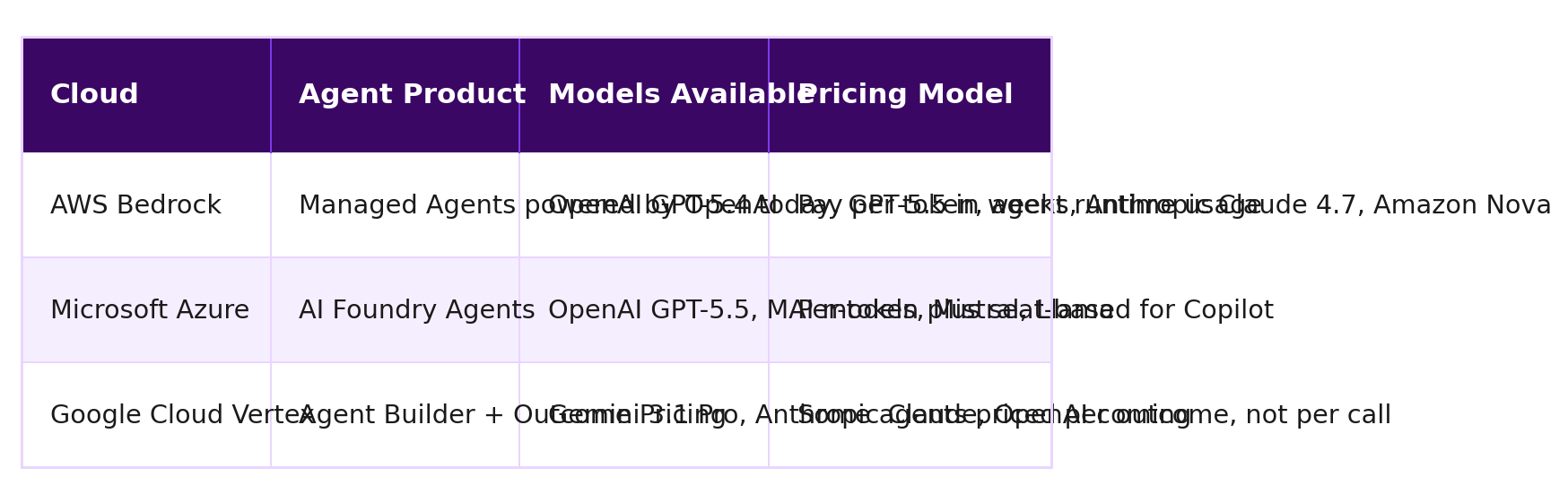
Every cloud has the same hand. The differentiator is which one already runs your business data (S&P Global, GeekWire).
Don't migrate clouds for AI. Buy the agent inside the cloud you're already on.
Common mistakes business owners are making this week
Mistake 1: Waiting for the Musk trial to resolve.
The trial could last a month and may delay OpenAI's IPO. None of that affects whether you should deploy a managed agent in May. The product is live regardless of who wins in court.
Mistake 2: Trying to build agents from scratch.
If your team is wiring together LangChain, a Pinecone database, and a custom auth layer in 2026, you're solving a problem the cloud already solved. Pull a managed agent template instead and spend your dev time on the parts that actually differentiate your business.
Mistake 3: Believing AI is "too risky."
The Wilbur Labs founders who flagged AI as a top threat are mostly right about the threat (PR Newswire). They're wrong about the response. Sitting it out doesn't reduce risk. It guarantees you face it without weapons.
Mistake 4: Not assigning an owner.
Every managed agent project needs one human accountable for prompt design, evals, and updates. Without that owner, the agent will drift, hallucinate, and cause problems.
How should I approach this in the next 30 days?
Three steps.
Step 1. Identify the single highest-cost manual workflow in your business. Customer support. Sales outreach. Bookkeeping. Pick one.
Step 2. Map it to a managed agent template inside whichever cloud you already use. AWS, Azure, or Google. If you're on none, AWS Bedrock is the simplest entry point right now because of the OpenAI launch.
Step 3. Run a 14-day pilot. Define one success metric. Compare results with humans. Decide whether to scale.
If that sounds like a lot, it's because most business owners are still learning what's possible.
That's exactly what my team helps with. We run free 1 on 1 AI Implementation Sessions where we map your workflows, identify the right managed agent for your stack, and build you a 90-day rollout plan that fits your team and budget.
Grab a spot here: https://go.8fig.ai/1-on-1
If you want a starting point you can explore on your own, the 8 Figure AI Toolkit includes our AI Tool & Tech Stack Picker to help match the right managed agent setup to your business model.
The window of advantage is open right now. It closes the day every competitor in your niche has a managed agent live.
FAQ
Q: What is Amazon Bedrock Managed Agents powered by OpenAI? A: A new AWS product that lets enterprises deploy AI agents inside their existing AWS environments, with security, identity, and procurement controls built in. Launched in limited preview on April 28, 2026 (EdTech Innovation Hub).
Q: Which OpenAI models are available on AWS now? A: GPT-5.4 is available immediately in limited preview on Bedrock. GPT-5.5 is expected within a couple of weeks per AWS CEO Matt Garman. Codex, OpenAI's coding agent, is also live (The Register).
Q: Should I switch from Azure to AWS to use OpenAI now? A: No. Both clouds host OpenAI models, and both have managed agent products. Pick the cloud already running your data, identity, and billing. The whole point of the new arrangement is that you don't have to migrate.
Q: Is AI really the biggest threat to my startup? A: According to Wilbur Labs' 2026 report, half of founders surveyed think so. The framing matters. AI is a threat to businesses that don't deploy it and an asset to ones that do (Wilbur Labs).
Q: What's the difference between an AI model and a managed agent? A: A model is the raw intelligence. An agent is the model plus tools, memory, prompts, and guardrails to actually do a job. A managed agent is an agent your cloud provider operates for you, so you don't build the wiring yourself.
TL;DR
- OpenAI's GPT-5.4, Codex, and Amazon Bedrock Managed Agents powered by OpenAI all went live on AWS in limited preview on April 28, 2026.
- Wilbur Labs reported 50% of founders see AI as the top threat, 59% are worried about surviving 12 months.
- The barrier to deploying AI just collapsed. The cost of not deploying it just doubled.
- This is The Managed Agent Default, the shift from custom AI builds to off-the-shelf agents bought from your cloud, like databases or storage.
- Hyperscaler CapEx is jumping from $379B to $622B in 2026 to power this shift.
- The right move is to pick one workflow, map it to a managed agent inside your existing cloud, and run a 14-day pilot.
The window of advantage is open right now. It closes the day every competitor in your niche has a managed agent live.
Rooting for you.