OpenAI's Worst Week and The AI Lock-In Tax: Why Vendor-Neutral Is the New Default
OpenAI lost its exclusive grip on Microsoft, watched its founder go to trial, and got reported as missing its own sales targets, all in 72 hours.
Today, April 28, 2026, opening statements began in Musk v. Altman in Oakland federal court (Reuters).
The same week, OpenAI and Microsoft announced the end of Microsoft's exclusivity, freeing OpenAI to sell on AWS, Google Cloud, and beyond (VentureBeat).
And the Wall Street Journal reported OpenAI has missed several monthly sales targets in 2026 as Anthropic gained ground in coding and enterprise (Bloomberg, NYT).
The lesson for business owners isn't "OpenAI is in trouble." It's bigger.
The era of betting your operations on a single AI vendor is officially over.
What just changed between Microsoft and OpenAI?
Monday's joint announcement gutted the most consequential exclusivity deal in tech.
Under the old terms, Azure was the only cloud where you could access OpenAI's models. Under the new terms:
- OpenAI can sell on AWS, Google Cloud, and any other provider (VentureBeat)
- Microsoft stops paying OpenAI a revenue share entirely
- OpenAI continues paying Microsoft 20% through 2030, now subject to a capped total
- Microsoft's license to OpenAI IP runs through 2032 and is now non-exclusive
- The "AGI trigger" clause that defined the original deal has been replaced with fixed calendar dates (VentureBeat)
Within weeks, OpenAI's models will be live on AWS Bedrock alongside Amazon's new Stateful Runtime Environment (Fortune).
Sam Altman summed it up in one X post: "We have updated our partnership with Microsoft." That's the corporate version of "we're seeing other people now."
Why did it happen? Money.
In February, Amazon committed up to $50 billion to OpenAI, with $15 billion upfront. OpenAI agreed to spend $100 billion on AWS over eight years and make AWS the exclusive third-party distributor for its agent platform, Frontier (VentureBeat).
That promise broke OpenAI's existing exclusivity contract with Microsoft. Microsoft was reportedly weeks away from suing. The new deal made the conflict go away.
Why is the Musk v. Altman trial happening right now?
Opening arguments started today in Oakland federal court in front of Judge Yvonne Gonzalez Rogers, with a nine-person jury sworn in Monday (BBC, Reuters).
Elon Musk co-founded OpenAI with Sam Altman in 2015 as a nonprofit. He left in 2018 over a power struggle. He claims OpenAI's transition to a for-profit structure defrauded him of roughly $40 million in donations (BBC).
Last year Musk and a group of investors offered $97.4 billion to buy OpenAI's nonprofit assets. OpenAI rejected it. The company is now reportedly tracking toward an IPO valued near $850 billion (BBC).
Witnesses expected on the stand include Microsoft CEO Satya Nadella, OpenAI co-founder Ilya Sutskever, and former CTO Mira Murati.
Why does this matter beyond Silicon Valley drama?
Because Musk's case is, in part, about whether one of the most influential AI companies on earth will be forced to restructure or hand back assets in the middle of a billion-dollar customer pipeline.
If you're running a business that relies on ChatGPT, Codex, or any OpenAI API, you now have a non-zero chance that your provider's corporate structure changes by court order. That's a vendor risk that didn't exist last quarter.
What is the AI Lock-In Tax?
Let me name what's happening so you can plan around it.
The AI Lock-In Tax is the hidden cost of building your business operations on a single AI vendor's stack.
It shows up in five places:
- Pricing risk. When the vendor moves prices, you have no leverage.
- Outage risk. When the vendor or its cloud goes down, you go down.
- Roadmap risk. When the vendor shifts focus, your workflows break.
- Legal risk. Lawsuits, exclusivity disputes, and regulatory action can block your access overnight.
- Capability risk. A single vendor will rarely be the best at every task you need.
For most of 2024 and 2025, the AI Lock-In Tax was invisible. ChatGPT was so far ahead that the cost of betting on it felt like zero.
This week made the tax visible.
OpenAI itself just paid the Lock-In Tax. Being locked into Azure cost them enterprise deals to Anthropic and Google, contributed to missed sales targets, and forced a $50 billion dollar maneuver to escape the cage (NYT).
If the most valuable private AI company on the planet can't afford single-vendor exposure, neither can your business.
How are smaller competitors gaining ground on OpenAI?
The Wall Street Journal reported, via Bloomberg and the NYT, that OpenAI fell short of monthly sales targets in 2026 as Anthropic gained share in coding and enterprise markets (Bloomberg, NYT).
Internally, OpenAI was aiming for 1 billion weekly active ChatGPT users by the end of 2025. They have not publicly confirmed hitting that mark and have lost users to rivals (NYT).
Three things are happening simultaneously.
One. Anthropic's Claude is winning developer preference. Earlier this quarter, Claude Sonnet 4.6 was chosen over Claude Opus 4.5 by 59% of developers, and Anthropic captured over 50% of enterprise API spend, leapfrogging OpenAI (Air Street Press).
Two. Google's Gemini App crossed 750 million monthly active users with Gemini 3.1 Pro setting state-of-the-art benchmarks (Air Street Press).
Three. Open-weight Chinese models like Zhipu's GLM-5 are pricing 6x cheaper than premium models, pulling cost-sensitive workloads away from US frontier vendors (Air Street Press).
Translation: there is no single winner. There hasn't been one for months. Most business owners just hadn't noticed yet.
How do business owners pay the AI Lock-In Tax without realizing it?
Here are five symptoms I see in client audits every week.
Symptom 1. "Our entire workflow lives in one ChatGPT thread."
Symptom 2. "All our automations call one model. If it changes, our whole pipeline breaks."
Symptom 3. "We pay one premium subscription per seat, even for tasks a smaller model could handle for 1/20th the price."
Symptom 4. "When the vendor had an outage last month, our team lost a full day."
Symptom 5. "We don't have any documentation of which model is doing what work in our business."
If three or more of these are true, you are paying the Lock-In Tax, you just haven't seen the invoice yet.
How do I build a vendor-neutral AI stack?
This is the real opportunity inside this week's news.
Here is the four-layer playbook we use with our clients.
Layer 1: Document every AI workflow you have.
Walk through customer acquisition, onboarding, fulfillment, support, finance, and ops. List every place AI touches the business. Most owners are shocked by how scattered it is.
Layer 2: Match each task to the right model, not the most popular one.
Heavy reasoning and code generation, Claude or GPT-5.5. Long-context document analysis, Gemini. High-volume, low-cost classification, an open-weight model. Voice, ElevenLabs. Don't let one logo run your whole business.
Layer 3: Use a router or orchestration layer.
Tools like LangChain, n8n, Zapier with multi-model actions, or a custom proxy let you swap providers without rewriting workflows. The goal is that a price hike, lawsuit, or outage from any single vendor changes one config line, not your whole roadmap.
Layer 4: Own your prompts, your data, and your evals.
Your prompts are intellectual property. Store them in a Git repo or shared doc, not buried in chat history. Build a small evaluation set so you can A/B-test models before swapping.
This is exactly what the 8 Figure AI Toolkit was built for. Our AI Tool & Tech Stack Picker lays out the right model for every task in your business so you stop overspending on premium tier subscriptions you don't need.
How does this compare across the major AI providers right now?
Quick snapshot of the four pillars in the multi-cloud AI era.
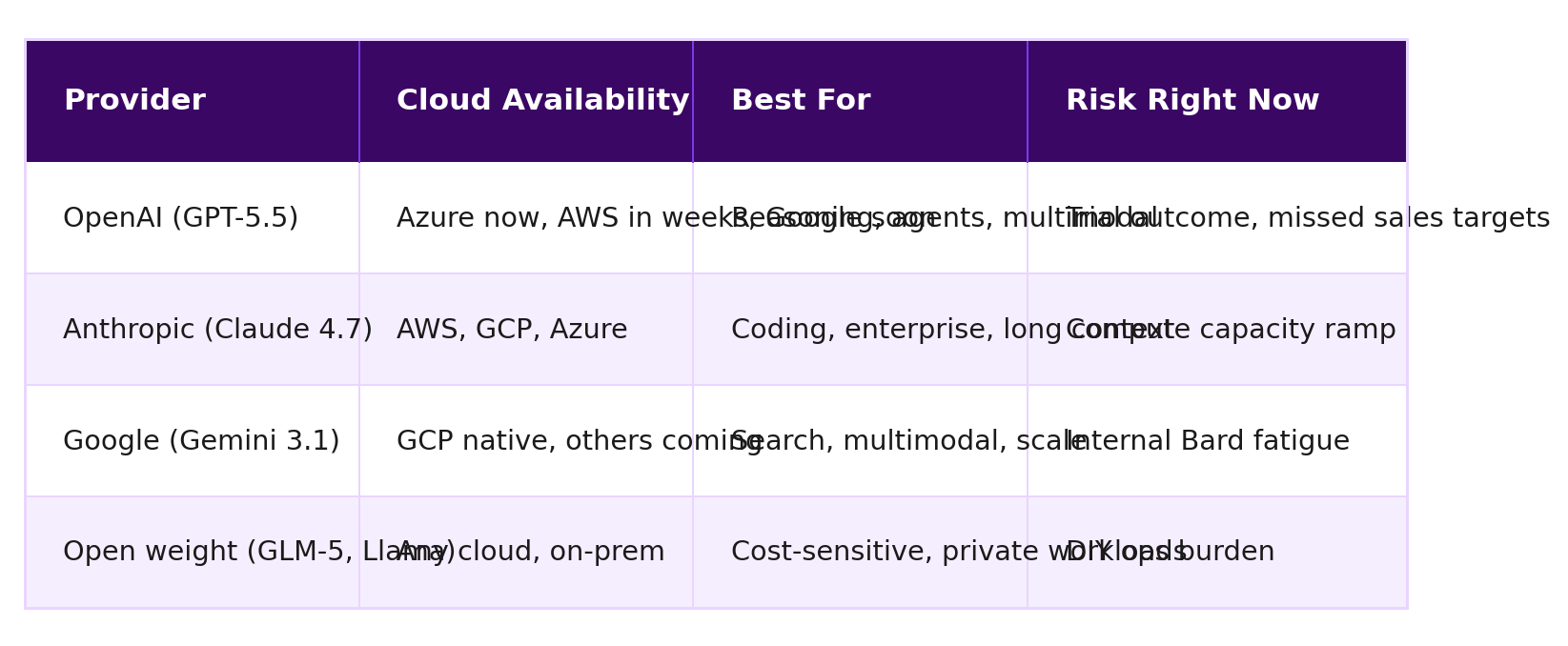
Notice something? Every column has a real risk. There is no "safe" pick. There is only the cost of being locked into one (Air Street Press, VentureBeat).
Common mistakes business owners are making this week
Mistake 1: Watching the Musk trial like it's reality TV.
It's a leading indicator about your AI provider's stability, not entertainment. Read the headlines like you would read about a key supplier's lawsuit.
Mistake 2: Assuming "OpenAI losing share" means you should switch.
The right move isn't to switch. It's to diversify. One vendor won the last 18 months. A different one might win the next 18.
Mistake 3: Doubling down on one chat tool because the team likes it.
Comfort with a tool is not a strategy. Your customers don't care which logo runs your back office.
Mistake 4: Ignoring the AWS Bedrock multi-model story.
Within weeks, your AWS account can run OpenAI, Anthropic, and Amazon's own models in one console with one bill (Fortune). That's a quiet but massive shift in how small businesses can buy AI.
What should I do this week to start escaping the Lock-In Tax?
Three moves you can finish before Friday.
Move 1. Spend 30 minutes writing down every place AI shows up in your business. Tools, models, prompts, automations, who owns each one.
Move 2. Pick the single most critical workflow on that list and test it on at least one alternative model. ChatGPT user? Run it through Claude. Gemini user? Run it through GPT-5.5. Compare the output.
Move 3. If it's high stakes, get expert eyes on the stack before you keep building.
That last move is the one I'd love to help with.
My team runs free 1 on 1 AI Implementation Sessions where we map your full AI footprint, find the Lock-In Tax in your operations, and build you a vendor-neutral stack so you stop paying for fragility. We've done this with operators in coaching, services, real estate, e-commerce, and consulting.
Grab a spot here: https://go.8fig.ai/1-on-1
Don't wait until your provider's logo is in a courtroom or a press release.
FAQ
Q: Is OpenAI actually losing the AI race? A: It's losing some battles, not the war. OpenAI still leads consumer ChatGPT usage and has the largest private valuation in tech history. But Anthropic is winning developer preference and enterprise spend, and Google is winning total monthly active users on Gemini (Air Street Press). The market is splintering, not consolidating.
Q: Did Microsoft lose in the new OpenAI deal? A: Microsoft lost exclusivity but kept the upside. It still owns about 27% of OpenAI's for-profit entity, retains its IP license through 2032, gets first access to OpenAI launches on Azure, and stops paying revenue share to OpenAI. Last quarter alone Microsoft reported $7.5 billion in OpenAI-related revenue (VentureBeat).
Q: What is the Musk v. Altman trial actually about? A: Musk alleges OpenAI defrauded him by transitioning from a nonprofit to a for-profit and abandoning its founding mission. He's seeking billions in "wrongful gains" and a restructuring that could include Altman's removal. OpenAI says Musk is acting out of jealousy after his own competing firm xAI fell behind (BBC).
Q: Should small businesses worry about the Microsoft-OpenAI changes? A: Long term, no. Short term, yes. You should treat any single AI vendor like a key supplier and have at least one backup model and one backup provider before you build deeper automations on top of them.
Q: What is a vendor-neutral AI stack in plain English? A: It's a setup where you can swap which AI model runs a given task without rebuilding the workflow. Usually that means storing prompts separately, using an orchestration tool like n8n or LangChain, and pre-testing 2 or 3 models on your most important tasks.
TL;DR
- OpenAI's worst 72 hours: Microsoft exclusivity ended, Musk v. Altman trial began, WSJ reported missed sales targets (VentureBeat, BBC, NYT).
- Anthropic now commands 50%+ of enterprise API spend. Gemini App crossed 750M MAU. Chinese open-weight models are 6x cheaper.
- Single-vendor AI dependence is now a measurable risk called The AI Lock-In Tax.
- Vendor-neutral stack playbook: document workflows, match tasks to the right model, add a router layer, own your prompts and evals.
- This week is your warning shot to diversify before the next OpenAI-style headline forces your hand.
You don't need to predict who wins the AI race. You need a business that wins regardless of who does.
Rooting for you.