What Does Stanford's 2026 AI Index Report Mean for Business Owners, and Why Is AI Spreading Faster Than the Internet?
Stanford just dropped a 423-page report that tells you exactly where AI stands right now. Not opinions. Not predictions. Data.
And the data says one thing very clearly: most business owners are not moving fast enough.
The 2026 AI Index Report from Stanford's Institute for Human-Centered Artificial Intelligence was published this week, and it is the most comprehensive annual snapshot of where artificial intelligence actually stands across investment, adoption, technical capability, workforce impact, and public sentiment.
Here are the numbers that matter for your business.
How Fast Is AI Being Adopted Compared to the Internet?
Faster.
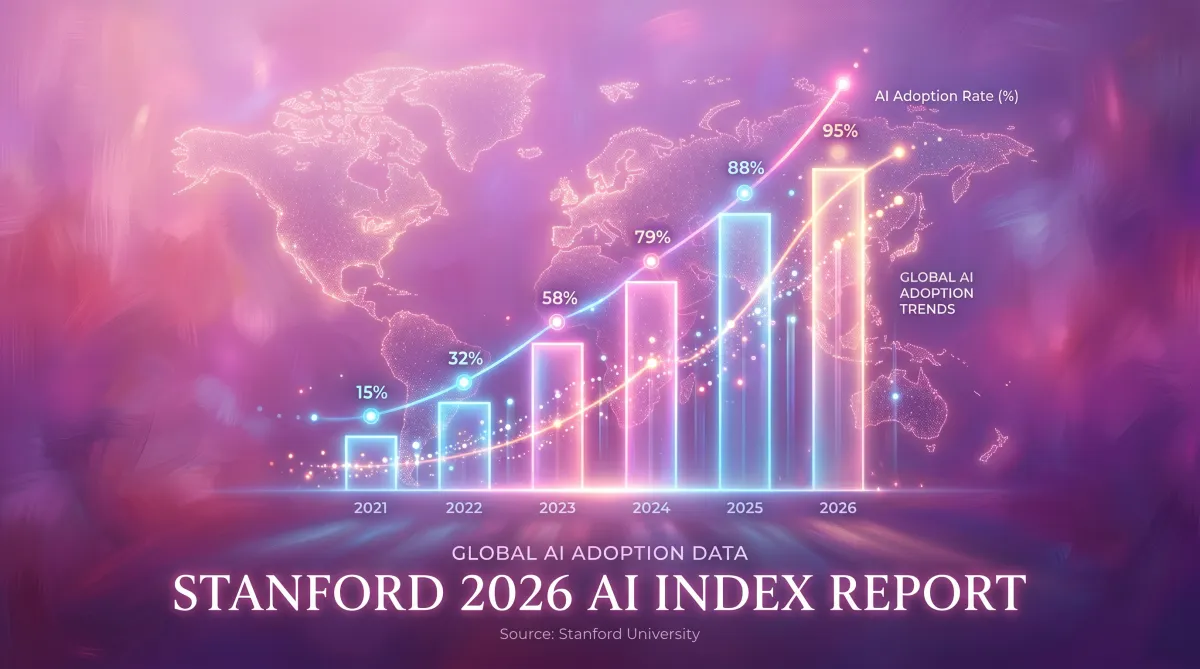
Generative AI reached 53% population-level adoption within three years of ChatGPT's launch in November 2022. That is faster than the personal computer and faster than the internet reached comparable adoption levels over the same time frame.
But the adoption numbers are not evenly distributed.
Singapore leads globally at 61%. The United Arab Emirates sits at 54%. The United States, despite leading the world in AI investment, ranks 24th at just 28.3%.
At the organizational level, 88% of companies in the tech sector now use AI. Across all industries, 70% of organizations use generative AI in at least one business function.
But here is the number that should stop every business owner in their tracks: AI agent deployment is still in the single digits across nearly all business functions.
That means the technology exists. The tools are available. And almost nobody is actually using them at full capacity.
This is the biggest gap in business right now.
What Is the Readiness Gap and Why Does It Matter?
I call this The Readiness Gap, and it is the defining competitive advantage of 2026.
Here is what the Stanford data shows.
On one side, AI capability is accelerating beyond what most people realize. On OSWorld, a benchmark that tests AI agents on real computer tasks across Windows, Mac, and Linux, the best models jumped from roughly 12% success in early 2024 to 66.3% today. That is within 6 percentage points of human performance.
On WebArena, which tests autonomous web agents, success rates climbed from 15% in 2023 to 74.3% in 2026, within 4 percentage points of humans.
On SWE-bench, which measures autonomous software engineering, performance rose from 60% to near 100% of the human baseline in a single year.
On the other side, most businesses have barely started deploying these capabilities. Agent deployment sits in single digits. Most companies are still using AI for basic text generation, if they use it at all.
The Readiness Gap is the distance between what AI can now do and what your business is actually using it for. And according to Stanford, that gap is enormous.
The businesses that close this gap first will dominate their markets. The ones that wait will spend the next three years wondering what happened.
How Much Money Is Being Invested in AI Right Now?
The investment numbers are staggering.
Global corporate AI investment hit $581.7 billion in 2025, up 130% from the prior year. Private investment alone reached $344.7 billion, a 127.5% increase.
The United States accounted for $285.9 billion of that, which is 23 times greater than China's tracked private investment of $12.4 billion.
Generative AI led the surge, growing more than 200% and capturing nearly half of all private AI funding. Newly funded AI companies rose 71%. Billion-dollar funding rounds nearly doubled.
The estimated value of generative AI tools to U.S. consumers alone reached $172 billion annually by early 2026, up from $112 billion a year earlier. The median value per user tripled in just one year.
For business owners, this is not abstract. It means your competitors, your vendors, and your customers are all being reshaped by AI capital. The tools you use will improve dramatically. But so will the tools your competitors use.
The companies investing in AI readiness now are building moats. The ones that are not are building vulnerabilities.
Is AI Actually Replacing Jobs Right Now?
Stanford's data gives a nuanced answer: yes, but selectively.
Employment for software developers ages 22 to 25 has fallen nearly 20% since 2024. A similar pattern appeared in customer service and other roles with high AI exposure. Employment for older, more experienced developers is actually rising.
One-third of surveyed organizations expect to reduce their workforce in the coming year as a result of AI. Expected cuts are highest in service operations, supply chain management, and software engineering.
But the productivity numbers tell the other side of the story.
Studies cited in the report show gains of 14% to 15% in customer support, 26% in software development, and up to 50% in marketing output. These are not marginal improvements. They are step-change increases in output per person.
AI experts forecast that the technology will assist in 80% of U.S. work hours by 2030. The general public estimates just 10%.
That 70-point gap between expert expectations and public perception is another version of The Readiness Gap. The people building AI see a completely different future than the people who will be affected by it.
For business owners, the practical takeaway is this: AI is not replacing every job. It is replacing specific tasks within jobs, starting with the most structured and repetitive ones. The businesses that redesign roles around AI augmentation will get the productivity gains. The ones that ignore the shift will face the job displacement.
What Should Business Owners Learn From the AI Hiring Boom?
AI-related job postings now make up 2.5% of all U.S. job listings, up 55% from last year and nearly 300% over the past decade.
But the biggest signal is what kind of AI skills are growing.
According to Lightcast's analysis of the Stanford data, job postings for "agentic AI" skills grew 280% in a single year, from 0.06% to 0.23% of all postings. That represents roughly 90,000 U.S. job postings mentioning agentic systems.
Python remains the most in-demand specialized skill, appearing in over 258,000 postings, up 391% from the 2013-2015 baseline. But the fastest-growing skills are deployment-oriented: AWS, scalability, workflow management.
Lightcast puts it bluntly: "AI is no longer just a frontier technology. It is becoming business infrastructure."
For business owners, you do not need to learn Python. But you do need to understand what agentic AI means for your operations. The job market is telling you where the value is moving. It is moving from chatbot-level AI to systems that take autonomous action inside real business workflows.
If you are not exploring how agentic AI applies to your sales, customer support, fulfillment, or marketing, you are already behind the curve the job market is pricing in.
How Should Business Owners Use This Data to Make Decisions?
Here is a four-step action plan based on the Stanford report.
Step 1: Benchmark your AI usage. Stanford says 70% of organizations use AI in at least one function, but agent deployment is in single digits. Where does your business fall? List every place you currently use AI and every place you should be using it but are not. That list is your Readiness Gap.
Step 2: Prioritize the 50% gain. Marketing output showed the highest productivity gain at 50%. If you are a business owner creating content, running ads, writing emails, or managing social media, that is where AI gives you the biggest return today. Start there.
Step 3: Audit your entry-level roles. Stanford documents a 20% employment decline for young software developers. If your business relies on entry-level workers for structured tasks, map out which of those tasks AI could handle in the next 12 months. This is not about firing people. It is about knowing where the disruption will hit your team and preparing for it.
Step 4: Close The Readiness Gap this quarter. Pick one business function where AI agents could handle multi-step workflows autonomously: customer support, lead qualification, data entry, scheduling. Deploy a pilot this quarter. The Stanford data shows the capability is there. The question is whether your business will use it before your competitors do.
If you want help identifying exactly where AI fits in your business and building the implementation plan, we run complimentary AI Implementation Sessions with business owners. Book a time here.
What Risks Does the Stanford Report Highlight?
The report is not all upside.
Transparency is collapsing. The Foundation Model Transparency Index dropped from 58 to 40 in a single year. The most capable models now disclose the least about their training data, methods, and risk profiles. For business owners building on top of AI platforms, this means the tools you depend on are becoming less transparent, not more.
AI incidents are rising. Documented incidents rose to 362 in 2025, up from 233 in 2024. The six-month moving average hit 326, with a single-month peak of 435 in January 2026. As you deploy AI in your business, build review and oversight steps into every workflow.
Heavy reliance carries learning penalties. The report notes that heavy AI reliance may carry long-term learning penalties that slow skill development over time. For business owners, this means you should augment your team with AI, not replace the learning process. The humans on your team still need to develop judgment and expertise.
FAQ
Q: Where can I read the full Stanford 2026 AI Index Report? A: The full 423-page report is free at hai.stanford.edu/ai-index/2026-ai-index-report. It covers technical performance, economy, policy, education, research and development, public opinion, and workforce data across nine chapters.
Q: How fast is AI adoption compared to the internet? A: Generative AI reached 53% population-level adoption within three years of ChatGPT's launch. That is faster than either the personal computer or the internet reached comparable levels. However, the U.S. ranks 24th globally at 28.3% adoption despite leading in AI investment.
Q: Is AI replacing jobs in 2026? A: Selectively, yes. Employment for software developers ages 22 to 25 has fallen nearly 20% since 2024. One-third of organizations expect workforce reductions in the coming year. The highest expected cuts are in service operations, supply chain, and software engineering. But productivity gains of 14% to 50% are documented across multiple business functions.
Q: How much is being invested in AI globally? A: Global corporate AI investment hit $581.7 billion in 2025, up 130% from the prior year. U.S. private AI investment reached $285.9 billion. Generative AI captured nearly half of all private AI funding, growing over 200%.
Q: What is the biggest opportunity for business owners in the Stanford report? A: The Readiness Gap. AI agents can now complete real computer tasks at 66% to 74% of human performance, yet agent deployment across businesses remains in single digits. The businesses that deploy AI agents in customer support, marketing, sales, and operations this year will capture a disproportionate share of the productivity gains Stanford documents.
TL;DR
- Stanford's 2026 AI Index Report confirms generative AI reached 53% population adoption in three years, faster than the personal computer or the internet
- Global corporate AI investment hit $581.7 billion in 2025, up 130%, with the U.S. accounting for $285.9 billion in private investment alone
- AI agents jumped from 12% to 66% of human performance on real computer tasks in just two years, yet business deployment of agents remains in single digits
- Productivity gains are documented at 14-15% in customer support, 26% in software development, and up to 50% in marketing output
- Employment for young software developers (ages 22-25) fell nearly 20%, and one-third of organizations expect AI-driven workforce reductions in the coming year
- The Readiness Gap: the distance between what AI can now do and what most businesses are actually using it for is the biggest competitive opportunity of 2026
- Business owners who close this gap now by deploying AI agents in real workflows will capture outsized market share before their competitors catch up