
The Two-Track Hiring Doctrine: How To Put Every Role In Your Business On The Winning Side Of PwC's New AI Jobs Map
PwC dropped the biggest hiring report of the year this morning in London.
The 2026 Global AI Jobs Barometer analyzed more than one billion job ads across 27 countries to map how AI is reshaping the global labor market (PwC).
The headline is simple. The market has split.
There are now two distinct paths a role can take. One pulls humans up the value stack and pays them dramatically more. The other holds them in place and slowly hollows the role out.
Companies that figured this out first are growing headcount 52 percent, while companies still wired for the old map are stuck at 36 percent (PwC).
The "super-star" 20 percent did something more striking. 163 percent labor productivity gains since 2018 (PwC).
The report does not just describe the future. It describes a decision you have to make about every single role on your team this quarter, before the gap widens.
Here is the doctrine I am walking founders through this week.
What Does PwC's 2026 AI Jobs Barometer Actually Say?
Five numbers do most of the work.
One. Jobs requiring specific AI skills are growing 69 percent year over year, almost eight times faster than the overall jobs market at 9 percent (PwC).
Two. The average wage premium for workers with AI skills is now 62 percent, up from 57 percent last year (PwC).
That premium is not uniform. In consumer markets it reaches 118 percent. In government and public sector it sits at 16 percent (PwC).
Three. Companies most exposed to AI grew headcount 52 percent and wages 24 percent from a 2018 baseline. Least-exposed companies grew headcount 36 percent and wages 17 percent (PwC).
Four. Inside the most AI-exposed group, the top 20 percent of "super-star" companies pulled off 163 percent labor productivity growth, nearly five times the average (PwC).
Five. Entry-level roles have split sharply. AI-exposed entry-level jobs are now seven times more likely to require traditionally senior skills like judgment, leadership, and face-to-face interaction (PwC).
Those "seniorized" entry roles grew 35 percent since 2019. Other entry roles dropped 10 percent.
The report is built from 2.4 million US entry-level job ads on top of the global billion-job dataset (PwC).
So when you map these numbers together, a clear bifurcation emerges.
Professionalized roles like radiologists or recruiters, where AI handles the routine work and humans handle judgment, are seeing twice the job growth and 42 percent faster salary growth than democratized roles like IT service managers or medical secretaries, where AI just makes the work easier for anyone to do (PwC).
PwC's framing is direct. "The companies seeing the greatest returns on AI are using it to amplify human expertise, accelerate innovation and create entirely new sources of value. As a result, they are pulling further ahead on productivity and growth than companies that focus primarily on automation" (PwC).
That is the whole game. Amplify, do not automate.
Why Does The Two-Track Labor Market Actually Matter For My Business?
Three operational consequences hit your P&L this quarter.
First, your wage budget is now strategic, not administrative.
Workers with AI skills are commanding 62 percent more pay than peers without them (PwC).
Aofirs reported the median salary for AI-related positions has hit $157,000, with data analysis and mathematics roles reaching $170,000 (Aofirs).
If you keep posting jobs that do not list AI skills, top candidates assume you cannot tell the two tracks apart. They route around you to companies that can.
Second, your entry-level pipeline is being rebuilt without you.
35 percent growth in seniorized entry-level roles versus 10 percent decline in everything else means the bottom of every funnel is shifting (PwC).
Companies hiring junior people for judgment, leadership, and customer interaction, with AI handling the rote work, are building a very different bench. In 18 months that bench gap turns into a management gap.
Third, revenue per employee is now the metric you live or die by.
PwC's data shows industries most exposed to AI grew revenue per worker three times faster than industries least exposed (Aofirs).
That is not a marginal improvement. That is a different business model.
You cannot get to 163 percent productivity gains by holding the org chart still and dropping AI tools on top. You get there by redesigning the chart around the two tracks.
The fix is a doctrine, not a memo.
What Is The Two-Track Hiring Doctrine?
The Two-Track Hiring Doctrine is a 5-question audit you run against every role in your business.
The goal is simple. By the end of the audit, every role has a clear answer to "professionalized or democratized" and a 90-day plan to move toward the right side of the line.
Here are the five questions, with the right posture for each.
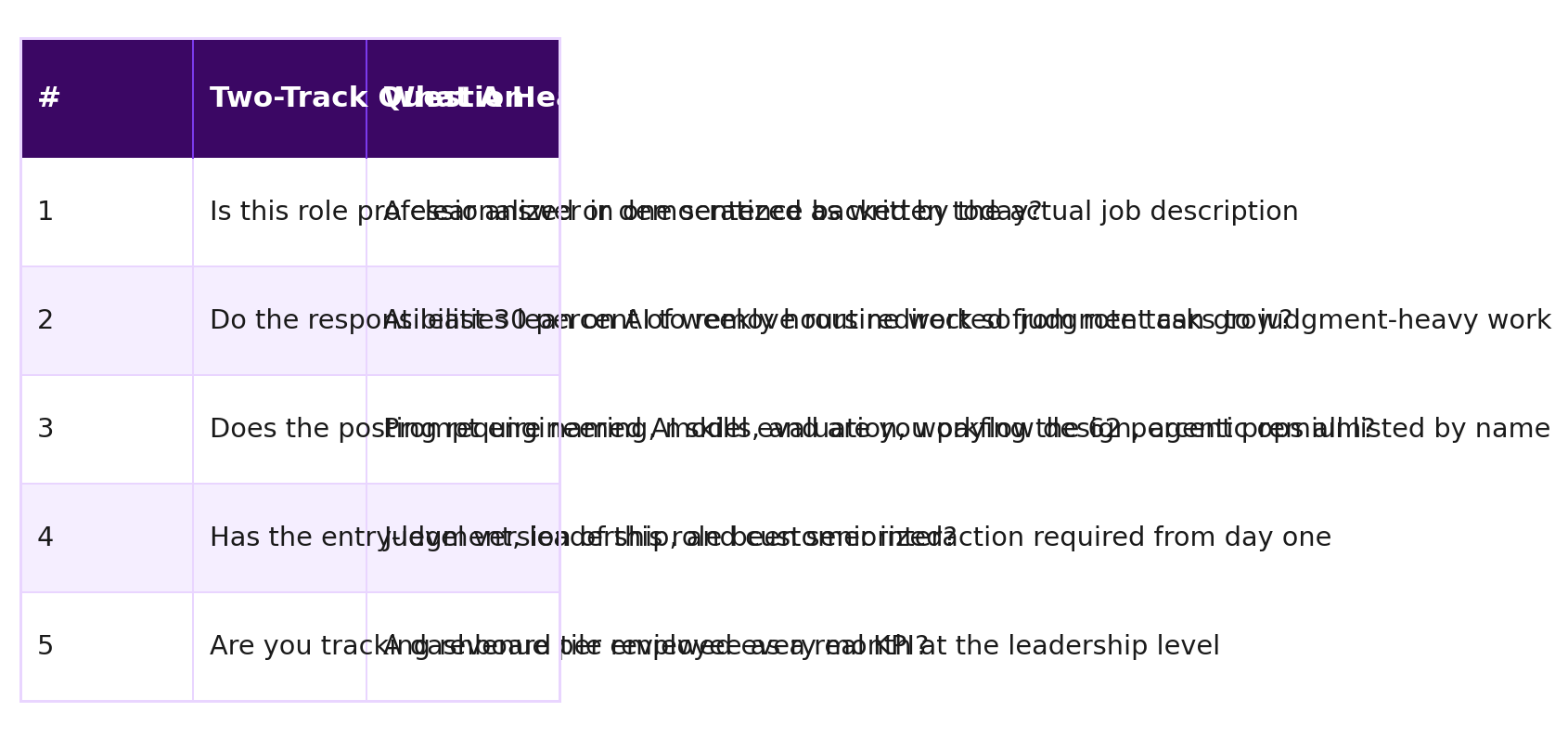
One doctrine. Five questions. One pass-fail per role.
A role that scores yes on all five sits on the professionalized track and qualifies for the 52 percent headcount growth and 24 percent wage growth PwC documented (PwC).
A role that fails one or more is bleeding value into the democratized track. Fix it before your next compensation cycle.
How Do I Apply The Two-Track Hiring Doctrine This Week?
Spend one 2-hour leadership block on this.
Step 1. List every role on your team. Title, headcount, responsibilities, current annual cost.
Step 2. Run the 5 questions against each role. Mark each as Professionalized, Democratized, or Mixed.
Step 3. For every Democratized or Mixed role, identify the highest-volume routine task currently consuming the hours of that role. Customer screening, basic data entry, first-draft writing, scheduling, level-one support.
Step 4. Pick the AI tool that can handle that task today and assign the freed hours to a single judgment-heavy initiative. New customer onboarding, retention calls, qualitative research, partner outreach.
The point is not to cut the role. It is to upgrade the role.
Step 5. Rewrite the job description for that role to require the AI skills it now uses. Name the tools. Name the workflows. Set the 62 percent premium math into your next compensation review.
Step 6. For every entry-level role on the list, ask one question. "If I were posting this today and wanted to seniorize it the way the 35 percent growth segment does, what judgment-heavy responsibility would I add?"
Add it. Reset the salary band. Reset the candidate profile.
Step 7. Build the revenue-per-employee dashboard. Pull last 12 months of revenue. Divide by average FTE. Track monthly. Set a 12-month target inspired by the 163 percent super-star benchmark, scaled to your business stage.
Seven steps. One afternoon. A reordered team by Monday.
What Does The Two-Track Hiring Doctrine Look Like For A Real Business?
Take a marketing agency doing $5 million a year with 28 employees.
Before the doctrine, the agency has account managers, copywriters, designers, paid media buyers, and a customer support team.
After running the doctrine, the picture changes.
Copywriters are reclassified from Democratized to Professionalized. AI handles 60 percent of first drafts. Their job now centers on conversion strategy, voice direction, and final-mile editing. Job descriptions rewritten to require prompt engineering and AI editing workflows. Compensation bands moved up 25 percent inside the year.
Designers move the same direction. AI handles ideation and asset variants. Humans own brand systems, art direction, and client review.
The customer support team's level-one ticketing moves to an AI agent. The team itself is reduced from six humans to two specialists earning more individually, with the remaining four redeployed into a new Retention Success unit doing onboarding calls and renewals.
Account managers are seniorized. The entry-level "junior account manager" job description gets rewritten to require client-facing judgment from day one, with AI workflows on top.
The revenue-per-employee dashboard goes live. Baseline $178,500 per FTE.
90 days later, headcount has moved from 28 to 25. Revenue is unchanged. Revenue per FTE rises to $200,000. Net team payroll is down slightly even after the compensation bumps for professionalized roles.
180 days later, the agency lands two new enterprise clients because the Retention Success unit drove a 22 percent referral lift.
This is what The Two-Track Hiring Doctrine does. It moves your org chart from automating routine work to amplifying expert work.
That is the move PwC's super-star companies made. Now it is your move.
What Should I Watch In The Next 90 Days?
Three items in order.
One. Your wage budget for renewals. If you do not adjust toward the 62 percent AI premium where it applies, your best AI-skilled people will field LinkedIn messages from competitors who do.
Two. The shape of your entry-level pipeline. Track applications, offers, and starts for both seniorized and traditional entry roles. Watch which one moves your retention numbers at the 12-month mark.
Three. Your industry's wage premium drift. PwC reports premiums as high as 118 percent in consumer markets and 16 percent in public sector (PwC). Know your number before you set band ceilings.
If you want help running The Two-Track Hiring Doctrine on your team, mapping every role against the 5 questions, and building a seniorized entry-level pipeline that compounds over the next 12 months, book a one on one AI Implementation Session here.
We will walk your org chart, score every role, and hand you a 90-day rebuild plan.
TL;DR
- PwC's 2026 Global AI Jobs Barometer released today analyzed more than one billion job ads in 27 countries and confirmed a two-track global labor market (PwC).
- Professionalized roles see 2x job growth and 42 percent faster salary growth than democratized roles.
- Companies most exposed to AI grew headcount 52 percent vs 36 percent and wages 24 percent vs 17 percent against a 2018 baseline (PwC).
- The top 20 percent "super-star" AI companies posted 163 percent labor productivity gains.
- AI-skill jobs grew 69 percent year over year vs 9 percent for the rest of the market, with a 62 percent average wage premium and median AI salaries near $157,000 (Aofirs).
- Entry-level AI-exposed roles are now 7x more likely to require senior skills, and those roles grew 35 percent since 2019 while others dropped 10 percent.
- The Two-Track Hiring Doctrine runs 5 questions per role: track classification, time redirected to judgment, named AI skills with premium pay, seniorized entry version, and revenue-per-employee tracking.
Frequently Asked Questions
Does this mean I should fire my democratized roles?
No. The doctrine is about upgrading roles, not eliminating them. Most democratized roles can move to the professionalized track by reclaiming routine hours and redirecting them to judgment-heavy work. Cuts only show up when the redesign does.
How fast should I implement the 62 percent AI wage premium?
Start with new hires and natural renewal cycles. Compensation jumps mid-cycle for AI-skilled staff who have other offers in hand are easier to justify against the public PwC numbers than across-the-board adjustments. Phase it in over two quarters.
What counts as an "AI skill" worth paying premium for?
Prompt engineering, model evaluation, retrieval architecture, agentic workflow design, AI quality assurance, and AI cost governance are the most commonly cited skills behind the 62 percent premium. Tool-specific certifications matter less than demonstrated portfolio work using the tools.
How do I seniorize an entry-level role without inflating its cost?
Redesign the responsibility set first, then test the new salary band against your local market. Many seniorized entry roles land 15 to 25 percent above the traditional band, which the productivity lift covers quickly when the role actually delivers judgment from day one.
Is the 163 percent productivity number realistic for a small business?
Not in year one. The 163 percent figure is the top 20 percent of the most AI-exposed companies measured against 2018. Most operators running the doctrine see 20 to 40 percent revenue-per-employee gains inside 12 months. The compounding is what matters.
The leaders who win the next twelve months will not be the ones who hired the most. They will be the ones who put every role on the professionalized track and paid the premium for the skills that compound.
PwC just drew the map. Now go run the audit.