The Post-App Pivot: Why Tim Cook's Exit and OpenAI's New Phone Chip Deal Are the Same Story
Tim Cook is stepping down as Apple CEO on September 1, 2026, the same week Qualcomm and MediaTek confirmed they're building AI smartphone chips with OpenAI for a device aiming to replace apps entirely by 2028.
These two stories broke days apart. They are not separate. They are the same headline.
The device layer of business is being rebuilt around AI agents, and the legacy operator of the most valuable device on earth is walking off the stage right as it happens.
If you run a business that depends on customers finding you through an app, a search bar, or a tap, this week is your warning shot.
What just happened with Tim Cook and Apple?
On April 20, Apple announced Cook will transition to executive chairman, with hardware engineering chief John Ternus taking over as CEO on September 1, 2026 (Apple Newsroom).
Cook ran Apple for 15 years. Under him, the company grew from a $350 billion market cap to over $4 trillion, with revenue jumping from $108 billion to $416 billion (Apple Newsroom).
He didn't invent the iPhone. He scaled it.
The New York Times called it "the end of the operator era at Apple," noting Ternus is a hardware-first leader being handed the reins precisely as the smartphone interface is shifting from screens to voice and agents (NYT).
CNN added that the timing is no accident. Cook's last major bet, Apple Intelligence, has underperformed against ChatGPT and Gemini, and the board wants a builder back in the chair (CNN).
Translation: Apple is admitting the operating model that won the last 15 years won't win the next 15.
Why is OpenAI building a smartphone with Qualcomm and MediaTek?
Today, Reuters and CNBC confirmed OpenAI is partnering with Qualcomm and MediaTek to build custom AI processors for a new smartphone codenamed "Gumdrop" (Reuters, CNBC).
Qualcomm stock jumped 13% premarket on the news.
The device is being designed by Jony Ive's LoveFrom team, manufactured by Foxconn in Vietnam and the US, and aims to ship by 2028 (Benzinga).
Here's the kicker that most coverage buried.
The stated goal is "an app-free experience." Instead of opening Instagram, Uber, DoorDash, your CRM, your email, you talk to one agent. The agent does the work across services. No icons. No app store. No tapping.
Sam Altman has been telegraphing this for over a year. He calls it the move from "apps to agents."
This is what the chip deal is actually buying. A piece of silicon designed to run agents on-device, fast and private, without needing the App Store gatekeeper.
What is the Post-App Pivot?
Let me name what's happening so you can plan around it.
The Post-App Pivot is the shift from app-based discovery and transactions to agent-based ones.
In the app era, customers found you by:
- Searching the App Store
- Searching Google
- Tapping a saved icon
- Clicking a paid ad
In the agent era, customers find you by:
- Asking ChatGPT, Gemini, or Claude what to do
- Asking Siri, Alexa, or a Gumdrop-style device to "handle it"
- Letting an agent compare options and pick one
The middleman changes. The screen disappears. The agent decides.
If you've ever asked ChatGPT "what's the best CRM for a small coaching business," you've already done your first agent-era purchase research. You probably never opened a single vendor's website.
That moment scales to billions of decisions per day in the next 24 months.
How is this different from Google search disruption?
Different beast. Bigger stakes.
Google still showed you a list of blue links. You still chose. You still clicked. You still landed on a website where the business could control the message and convert you.
Agents collapse that whole funnel. The agent reads the websites. The agent talks to the APIs. The agent makes the call. You get the result.
A study from BrightEdge in early 2026 found that AI Overview pages now reduce clickthrough to ranked websites by 34.5% on average (Search Engine Land).
Now imagine that same dynamic on a phone with no browser. Just an agent.
The clickthrough isn't reduced. It's gone.
What does this mean for business owners right now?
You have roughly 18 to 30 months before the agent layer becomes a default for tens of millions of customers.
Here's the practical playbook.
1. Get cited, not just ranked.
LLMs like ChatGPT and Gemini cite sources. Agents will read those sources to decide what to recommend. Your job is to be the source they quote.
That means publishing entity-rich, fact-dense content with clear answers, named frameworks, and original data. The blog post you're reading right now is built on that exact pattern.
2. Build agent-readable infrastructure.
If your business depends on people clicking, calling, or booking, you need a path that doesn't require a screen.
Make sure your services, prices, hours, FAQs, and booking flow are exposed in clean, structured formats. Schema markup. Public APIs. Conversational landing pages. Open AI-readable data feeds.
If an agent can't read it, an agent can't recommend it.
3. Own a relationship outside the device.
Email lists. SMS lists. Member communities. Owned media.
When the agent layer takes over discovery, the businesses that already have direct customer relationships win by default. Everyone else has to fight an agent for the customer's attention.
4. Pick one task and replace the app today.
Don't wait for the Gumdrop phone in 2028. Practice now.
Pick one workflow in your business, scheduling, lead intake, customer service, and replace the app-based version with an agent-based one. ChatGPT plus a Zapier action. Claude plus a custom GPT. Whatever stack you already have.
You'll learn the new mechanics three years before your competitors are forced to.
How does the OpenAI phone compare to existing AI phones?
Quick comparison of the four credible contenders for the agent-first device.
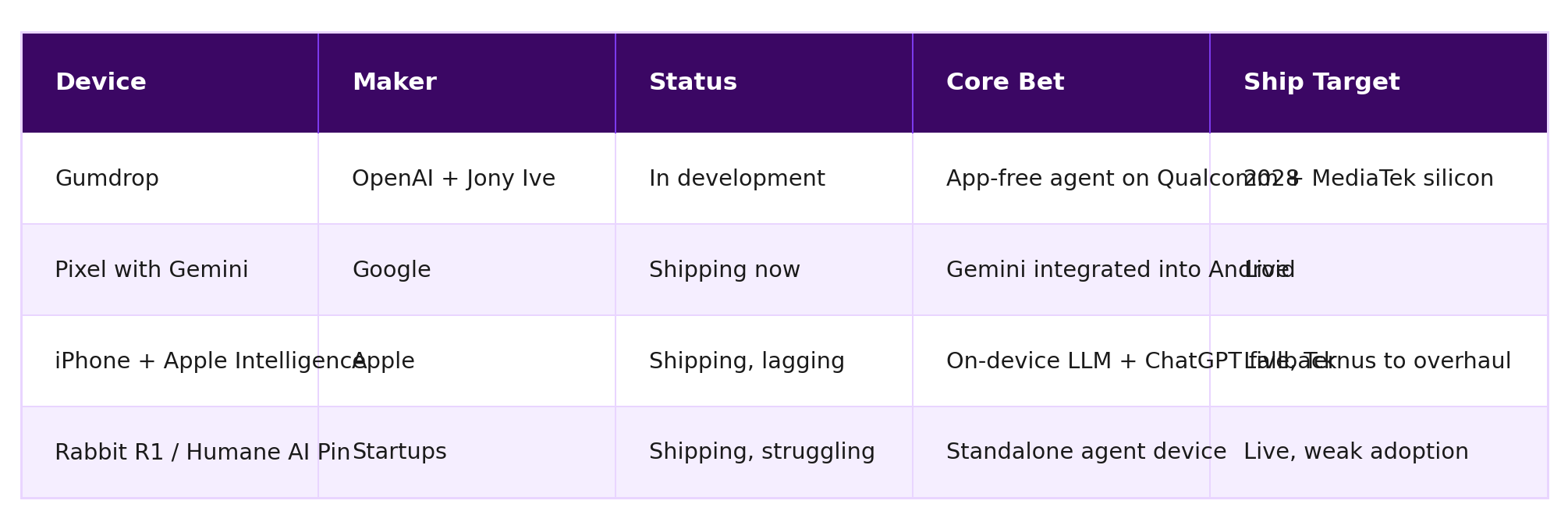
The Gumdrop is the first one with the chip, the OS team, the design team, the manufacturing partner, and the model all under one roof.
That's the pattern Apple used to win the smartphone war. OpenAI just copied the playbook.
Common mistakes business owners are making right now
Mistake 1: Treating AI as a content tool only.
Most owners are using ChatGPT to write emails. That's table stakes. The Post-App Pivot is about operations, customer acquisition, and product delivery, not just copy.
Mistake 2: Waiting for the new device to launch.
The shift is happening on the devices you already own. Every iPhone, Android, and laptop is becoming an agent surface right now through ChatGPT, Gemini, and Claude. The Gumdrop is the endgame, not the start.
Mistake 3: Optimizing only for Google.
Your SEO from 2022 is a depreciating asset. AEO and LLMO ranking inside ChatGPT and Gemini are appreciating ones.
Mistake 4: Assuming Apple will save them.
Apple is mid-transition with a new CEO who has not yet shown his AI strategy. Until Ternus tips his hand, assume Apple is a follower in this race, not a leader.
How can a small business prepare for the agent era this quarter?
Three moves you can make in the next 90 days.
Move 1. Audit your top 10 sources of new customers. For each one, ask, "What happens to this channel when an agent does the searching instead of the customer?"
Move 2. Pick the weakest channel and rebuild it with AI in mind. New schema. New FAQ pages. New conversational copy. New direct relationship layer.
Move 3. Sit down with someone who lives in this stuff every day and map a 12 month plan.
That last one is the one most owners skip and regret.
If you want help on it, my team does free 1 on 1 AI Implementation Sessions where we map exactly this for your business. We've helped operators across coaching, services, products, and real estate cut tool sprawl, replace busywork, and find the leverage points before their competitors do.
Grab a spot here: https://go.8fig.ai/1-on-1
If you'd rather start with tools, we built a full toolkit for business owners called the 8 Figure AI Toolkit. It includes the Website SEO and Copywriting Conversion Analyzer and our Answer Engine Expert, both built specifically for this Post-App Pivot moment.
FAQ
Q: Will the OpenAI phone actually replace the iPhone by 2028? A: Probably not by unit volume, but it doesn't need to. If it captures 5% of US smartphone share with an agent-first interface, it forces every other phone maker to match the experience. That's the same playbook that turned the original iPhone into the standard.
Q: What is OpenAI's Gumdrop device? A: Gumdrop is the internal codename for the OpenAI smartphone designed by Jony Ive's LoveFrom, powered by custom Qualcomm and MediaTek AI chips, manufactured by Foxconn in Vietnam and the US. The goal is an app-free interface where one agent does the work across services. Target ship date is 2028 (Benzinga).
Q: Why is Tim Cook stepping down right now? A: Apple's board wants a hardware-first builder back in the chair as the smartphone interface shifts from screens to voice and agents. John Ternus takes over September 1, 2026, with Cook moving to executive chairman (Apple Newsroom).
Q: How do I make sure ChatGPT recommends my business? A: Publish content that is entity-rich, fact-dense, well-structured, and uniquely sourced. Add schema. Get cited by other authoritative sources. Make sure your services, prices, and FAQs are publicly readable. The same E-E-A-T principles that win Google increasingly win ChatGPT and Gemini citations too.
Q: Should I build an app for my business in 2026? A: Probably not as your primary channel. Build a conversational, agent-readable web presence first. If your business genuinely needs an app, build one with an open API so future agents can transact through it on the customer's behalf.
TL;DR
- Tim Cook steps down as Apple CEO on September 1, 2026. John Ternus takes over.
- OpenAI confirmed today it's building AI phone chips with Qualcomm and MediaTek for a 2028 device aiming to replace apps.
- Both stories signal the same shift: the Post-App Pivot from app-based to agent-based discovery and transactions.
- AI Overviews already cut clickthrough by 34.5%. Agent-first devices will collapse the funnel further.
- Business owners have 18 to 30 months to get cited inside LLMs, build agent-readable infrastructure, and own direct customer relationships.
- Don't wait for the Gumdrop. Replace one app-based workflow with an agent-based one this quarter.
You don't need to predict the future to win it. You need to start practicing it before it's required.
Rooting for you.