The Model Sovereignty Doctrine: How To Build An AI Stack The Government Cannot Switch Off Overnight
On Friday, June 12 at 5:21pm Eastern Time, the United States government turned off the most powerful publicly available AI model in the world.
Commerce Secretary Howard Lutnick sent Anthropic CEO Dario Amodei a letter ordering the company to block all foreign nationals from accessing Claude Fable 5 and Claude Mythos 5 (NBC News).
Because Anthropic cannot reliably tell foreign nationals apart from anyone else in real time, the practical result was a hard worldwide shutoff for every customer of both models (StartupHub.ai).
The order covers "any foreign national, whether inside or outside the United States, including foreign national Anthropic employees" (StartupHub.ai).
This is the first time in history a publicly available frontier AI model has been pulled offline by direct federal action (NBC News). 48 hours in, Anthropic has no restoration timeline.
If you spent the last 72 hours rebuilding a workflow on Fable 5, your business just lost the model.
Here is the doctrine I am walking founders through this weekend so it never happens to your stack again.
What Actually Happened With Anthropic Fable 5 And Mythos 5?
The sequence matters because it shows how fast the legal authority moved.
Trump signed an executive order titled Promoting Advanced Artificial Intelligence Innovation and Security on approximately June 2, 2026, creating a voluntary framework where frontier AI developers can submit their most capable models to the federal government for up to 30 days of pre-release vetting (LinkedIn / Cyber News Live).
Ten days later, the Commerce Department used a completely separate authority, the existing Export Administration Regulations, to shut down Fable 5 after it was already deployed publicly (AIToolsRecap).
The trigger appears to be a jailbreak. Axios and CNBC reported that another company claimed it found a way to bypass Mythos's safety controls and alerted the administration (Nextgov).
Anthropic disputes the severity. Its public statement said the directive "did not specify" the national security concern and called the action a "misunderstanding," arguing the process was not "transparent, fair, clear, and grounded in technical facts" (Washington Times).
Other Claude models keep running. Opus 4.8, Sonnet, and Haiku are unaffected (StartupHub.ai).
And here is the kicker. Tomorrow, Monday June 15, two more Claude model IDs retire from the API with no grace period.
Both claude-sonnet-4-20250514 and claude-opus-4-20250514 stop responding at midnight. There is no rollback and no extension (AIToolsRecap).
If your code still calls those IDs in production, your integration breaks before Monday morning standup (ToolNav).
Two model events. Same week. Same vendor. Both forced. One by Washington, one by the vendor's roadmap.
This is the new operating environment.
Why Does The Government Shutting Off A Model Actually Matter For My Business?
Three reasons, in order of urgency.
First, model availability is now a regulatory variable, not a vendor variable.
For two decades, software risk meant outages, bugs, and price hikes. None of those are sovereign actions.
Friday changed that. A model can now be removed from your stack by a letter from a US cabinet secretary. The Washington Times called this "the U.S. government's most significant step to date to restrict access to the most advanced AI models" (Washington Times).
If your business runs critical workflows on a frontier model, your continuity now depends on a foreign-policy decision, not a service-level agreement.
Second, model IDs are now load-bearing infrastructure.
Anthropic's June 15 retirement of two specific model IDs is going to break production code at thousands of companies on Monday because most teams hardcoded the strings (Context Studios).
Anthropic's documented fix is to grep every repo, CI file, agent config, environment variable, and third-party integration for claude-sonnet-4-20250514 and claude-opus-4-20250514, then swap to claude-sonnet-4-6 and claude-opus-4-8 (Context Studios).
You have less than 24 hours.
Third, Agent SDK billing flips at the same moment.
Starting June 15, Anthropic moves Claude Agent SDK, headless Claude Code, Claude Code GitHub Actions, and any third-party agent off subscription limits onto a separate monthly credit pool billed at API rates (AIToolsRecap).
The credit pools land at $20 for Pro, $100 for Max 5x, and $200 for Max 20x (ToolNav).
If your headless agents currently chew through Sonnet tokens like water under your subscription, your monthly bill is about to step up sharply unless you cap or migrate.
Three concurrent shocks. One weekend to absorb them.
What Is The Model Sovereignty Doctrine?
The Model Sovereignty Doctrine is a 5-question test you run against every AI-dependent workflow in your business.
The goal is simple. By the end of the audit, no single decision by a vendor or a government can take your operation offline for more than 60 minutes.
Here are the five questions, with the right posture for each.
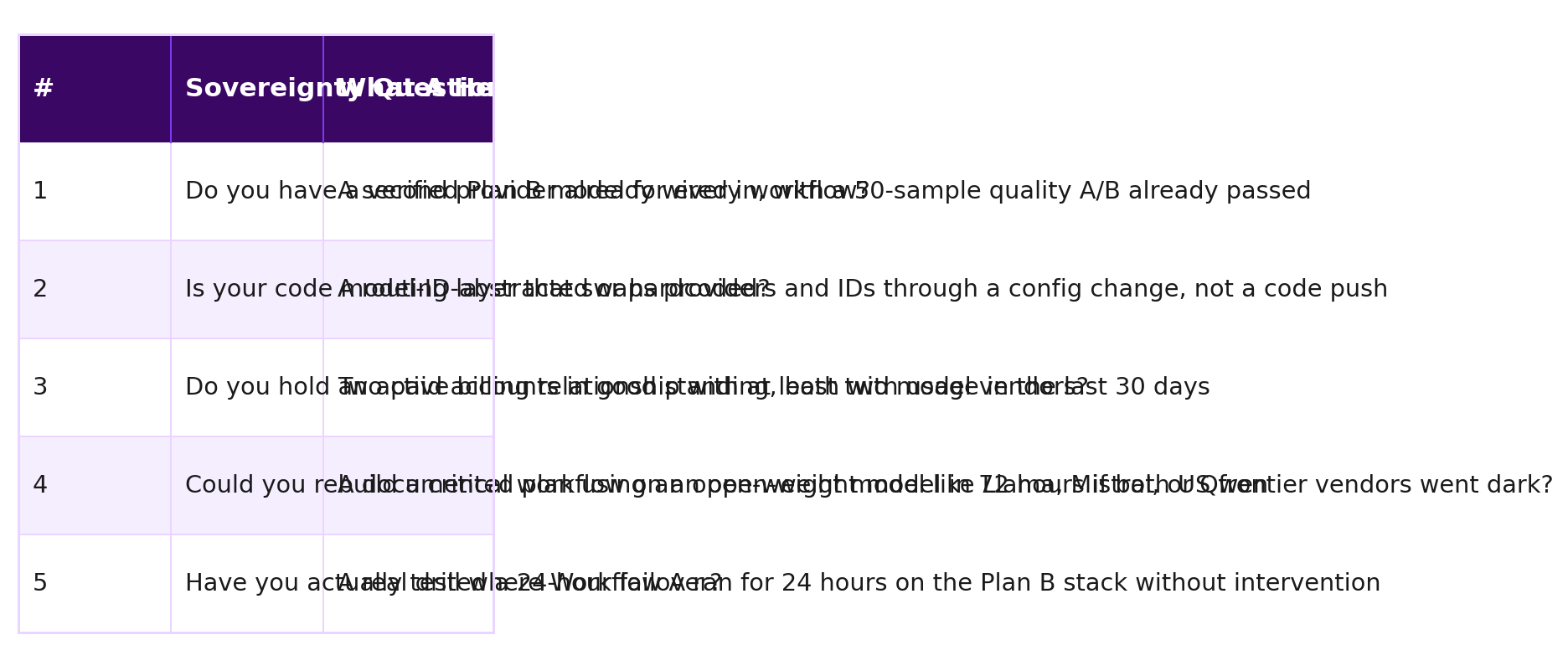
One doctrine. Five questions. One pass-fail per workflow.
A workflow that scores yes to all five is sovereign. It can survive a Friday letter from Commerce, a Monday model retirement, and a midnight billing change.
A workflow that fails one or more is exposed. Fix it before the next shock.
How Do I Apply The Model Sovereignty Doctrine This Weekend?
Step 1. Inventory every workflow that calls an AI model. Sales agent, support bot, content generator, internal copilot, agentic coding tool, data extractor.
For each, write the vendor, the model ID, and the monthly token spend.
Step 2. Grep your codebase tonight.
Search for claude-sonnet-4-20250514 and claude-opus-4-20250514 everywhere (ToolNav). Replace with claude-sonnet-4-6 and claude-opus-4-8. Run integration tests against the new IDs before deploying.
This is your 24-hour fire drill. Pricing stays the same on the new IDs, so the only risk is hardcoded strings (AIToolsRecap).
Step 3. Add a routing layer. Use OpenRouter, LiteLLM, Vercel AI SDK, or a homegrown abstraction so every workflow calls a logical name like "primary writing model" instead of a vendor ID.
When Anthropic, OpenAI, or Google moves a model, you change one config line.
Step 4. Open billing accounts with at least two providers. One frontier US vendor. One alternative. Many founders this week are pairing Anthropic with OpenAI, or pairing OpenAI with Gemini, plus a cheaper third option like DeepSeek or Qwen for commodity work.
The point is not to use all of them every day. The point is that the second provider is already provisioned with a working API key, so you can flip in minutes when you need to.
Step 5. Audit the Agent SDK migration. Pull your monthly headless usage from the Claude Console. Decide whether to stay on the credit pool, enable overflow billing, or restructure automation to stay within the pool (ToolNav).
If you skip this, you find out the answer on your June statement.
Step 6. Schedule a 24-hour failover drill within 14 days. Pick one important workflow. Switch it to your Plan B provider for a full day under real load. Document every break. Fix every break.
Drills you do not run will fail you on the day you actually need them.
What Does The Model Sovereignty Doctrine Look Like For A Real Business?
Take a coaching business doing $3 million a year with a Claude-powered sales assistant, a research agent for the founder, and a content engine running on Sonnet.
Before Friday, all three were single-vendor. Hardcoded claude-sonnet-4-20250514. No Plan B. No drill.
All three workflows fail four of the five sovereignty questions.
By Sunday night, the team does the following.
The sales assistant moves behind an abstraction layer. Primary set to claude-opus-4-8. Plan B configured against gpt-5.5 with a tested swap. Routing flips with a config push, not a code push.
The research agent stays on the most capable available model, but the founder authorizes a $200 Max 20x credit pool for Agent SDK so headless workflows do not break the subscription.
The content engine for bulk drafts moves to an open-weight stack on Qwen3.5 with Mistral fallback. The founder accepts a small quality tradeoff in exchange for full sovereignty on the highest-volume workflow.
By Monday morning, no part of the business can be taken down by a single letter from Commerce or a single deprecation from any one vendor.
Cost. Roughly six hours of focused work and a $200 monthly credit purchase.
A week ago, the cost of skipping this was theoretical. Friday made it real.
What Should I Watch In The Next 72 Hours?
Four items in order.
One. Anthropic restoration timing for Fable 5 and Mythos 5. The company says it hopes to restore access "as soon as possible" (Washington Times). Watch for guidance on safeguards and which jurisdictions return first.
Two. The June 15 model ID cutover. The two retiring IDs return errors with no warning at midnight UTC (AIToolsRecap). Production breakage will hit early Monday traffic for any team that did not migrate.
Three. The Agent SDK credit pool experience. Watch how teams with heavy headless usage respond. The signal will be in support threads and Reddit before it shows up in earnings.
Four. Whether OpenAI, Google, or Microsoft receive a similar order. The voluntary 30-day vetting framework now sits alongside an active Commerce authority that can pull a model after launch (AIToolsRecap). If a second vendor gets a letter, the doctrine becomes non-negotiable for every US company.
If you want help running The Model Sovereignty Doctrine on your business, mapping every workflow against the five questions, and standing up a tested Plan B before the next shock, book a one on one AI Implementation Session here.
We will walk your stack, identify your single-vendor exposure, and hand you a 14-day sovereignty plan you can execute with your existing team.
TL;DR
- The US Commerce Department issued an export control directive on June 12 at 5:21pm ET ordering Anthropic to block foreign-national access to Claude Fable 5 and Mythos 5 (NBC News).
- Anthropic could not separate foreign nationals from other users in real time and disabled both models worldwide for every customer (StartupHub.ai).
- The action used Export Administration Regulations authority, separate from the voluntary AI vetting framework Trump signed on June 2 (AIToolsRecap).
- Tomorrow, June 15,
claude-sonnet-4-20250514andclaude-opus-4-20250514retire from the API with no grace period (Context Studios). - Anthropic Agent SDK and headless Claude Code billing flips to a separate credit pool at API rates the same day, with $20, $100, and $200 tiers (ToolNav).
- The Model Sovereignty Doctrine asks 5 questions per workflow: Plan B model, model-ID abstraction, two-vendor billing, open-weight rebuild, and a tested 24-hour failover.
- A $3M coaching business can pass all five inside one weekend for roughly six hours of work and a $200 monthly credit purchase.
Frequently Asked Questions
Is the government shutdown of Fable 5 permanent?
Anthropic says no and is working to restore access. The Commerce Department has not published a restoration timeline. Plan as if the shutdown holds until you see official restoration guidance.
What is the safest fallback model right now?
For most production workloads, claude-opus-4-8 from Anthropic and gpt-5.5 from OpenAI are the two most capable models still fully available. Run your own quality A/B against your real prompts before committing.
Do I need to do anything before Monday June 15?
Yes. Grep your codebase, configs, environment variables, and CI files for claude-sonnet-4-20250514 and claude-opus-4-20250514. Replace with claude-sonnet-4-6 and claude-opus-4-8. Run integration tests. Deploy before midnight UTC.
Does the Agent SDK billing change affect interactive Claude users?
No. Claude.ai chat and interactive Claude Code terminal sessions stay on your existing plan. Only headless Claude Code, Claude Agent SDK, Claude Code GitHub Actions, and third-party agents move to the new credit pool.
Should I move my critical workflows to open-weight models now?
Not all of them. The right move is to have an open-weight Plan B documented and tested for each workflow, then keep the primary on whatever delivers the best quality at acceptable risk. Sovereignty is about options, not abandonment.
The leaders who win the next twelve months will not be the ones who picked the most powerful AI model. They will be the ones who built a stack no single vendor and no single government can take offline overnight.
Run the doctrine this weekend.