The Machine Majority Doctrine: Your Website Just Stopped Being For Humans
For the first time in internet history, machines outnumber humans on the open web.
Cloudflare CEO Matthew Prince posted the milestone on June 3, 2026. Automated requests now account for 57.5 percent of HTML web traffic. Humans hold 42.5 percent (Digital Applied).
Before the generative AI era, bot traffic sat near 20 percent. The shift from 20 to 57.5 took less than three years (X / Elias).
If you publish content, run an ecommerce store, or rely on a website to bring in leads, your visitor math is now broken.
You have been optimizing for the minority.
Here is what actually changed this week, and the doctrine I am walking founders through right now to stop bleeding traffic, revenue, and signal to the wrong audience.
What Just Happened With Bot Traffic in June 2026?
Three things landed inside ten days that, taken together, redraw the web for any business owner.
One. Cloudflare Radar confirmed the crossover. As of June 3, bots are 57.5 percent of HTML traffic on the open web (Digital Applied).
Roughly 51.8 percent of AI crawler requests went to model training in May 2026. Another 35.7 percent were mixed-purpose. Pure search retrieval was only 9.3 percent, up from 7.5 percent in April (Digital Applied).
Cloudflare's 2026 Threat Intelligence Report found that 94 percent of all login attempts across its network now come from bots, not humans (X / Elias).
Two. The UK Competition and Markets Authority dropped its first binding conduct requirement on Google under the Digital Markets Act on June 3. Google must give publishers a working opt-out from AI Overviews and AI Mode without dropping their organic rankings (Let's Data Science).
Google says the new Search Console toggle starts honoring opt-out settings on June 17, 2026, beginning with a subset of UK publishers and rolling out globally (Let's Data Science).
Three. Visa announced on June 10 that ChatGPT users can now connect Visa credentials directly to the assistant so AI agents can search, decide, and complete purchases inside approved spending, merchant, and approval limits (Los Angeles Times).
eMarketer forecasts 114.5 million net new ChatGPT users in 2026 alone (eMarketer).
So in ten days, the majority of your "visitors" became machines, your largest discovery channel offered a way to disappear from it, and your biggest payment network announced that the buyer at checkout might literally be an AI.
Your old website strategy was built for none of this.
Why Does The Machine Majority Actually Matter For My Business?
Three operational consequences hit your P&L this quarter.
First, your analytics lie now.
Raw visitor counts blend humans and bots. With bots at 57.5 percent of HTML requests, half or more of the "traffic" your dashboards celebrate is doing none of the things humans do. They are not adding to cart, signing up, or reading a single sentence end to end.
If you scale your ad spend or content production off blended visitor numbers, you are scaling to ghosts.
Second, your content discovery is changing identity.
A growing portion of bot traffic comes from AI summarizers that read your page once, ingest the answer, and serve it inside ChatGPT, Gemini, or Claude without sending a click back (Digiday).
ChatGPT now controls 54.7 percent of AI chatbot web visits worldwide, with Gemini at 27.4 and Claude at 8.2 (Tech Times).
When Google's opt-out flips on June 17, you face a hard choice. Stay in AI Mode and lose clicks to zero-click answers. Opt out and disappear from a feature most users will see before your blue link (Digiday).
Third, the buyer might no longer be a person.
Visa is rolling out agentic checkout with ChatGPT. Mastercard launched Agent Pay for Machines on June 10 across Stripe, Coinbase, Adyen, and Cloudflare. Coinbase opened tools letting AI agents trade and pay this week.
Your conversion funnel was designed for a human reading testimonials, comparing photos, and feeling persuaded. An AI agent reads structured data, checks merchant trust, and decides in milliseconds.
If your site is not structured for agents, you are quietly losing share to a competitor whose site is.
The fix is not panic. It is reclassification.
What Is The Machine Majority Doctrine?
The Machine Majority Doctrine is a 5-bucket reclassification of every visitor your website receives, with a different posture for each.
Stop treating traffic as one number. Start treating it as five distinct audiences with five distinct jobs to be done.
Here are the buckets, with the right response for each.
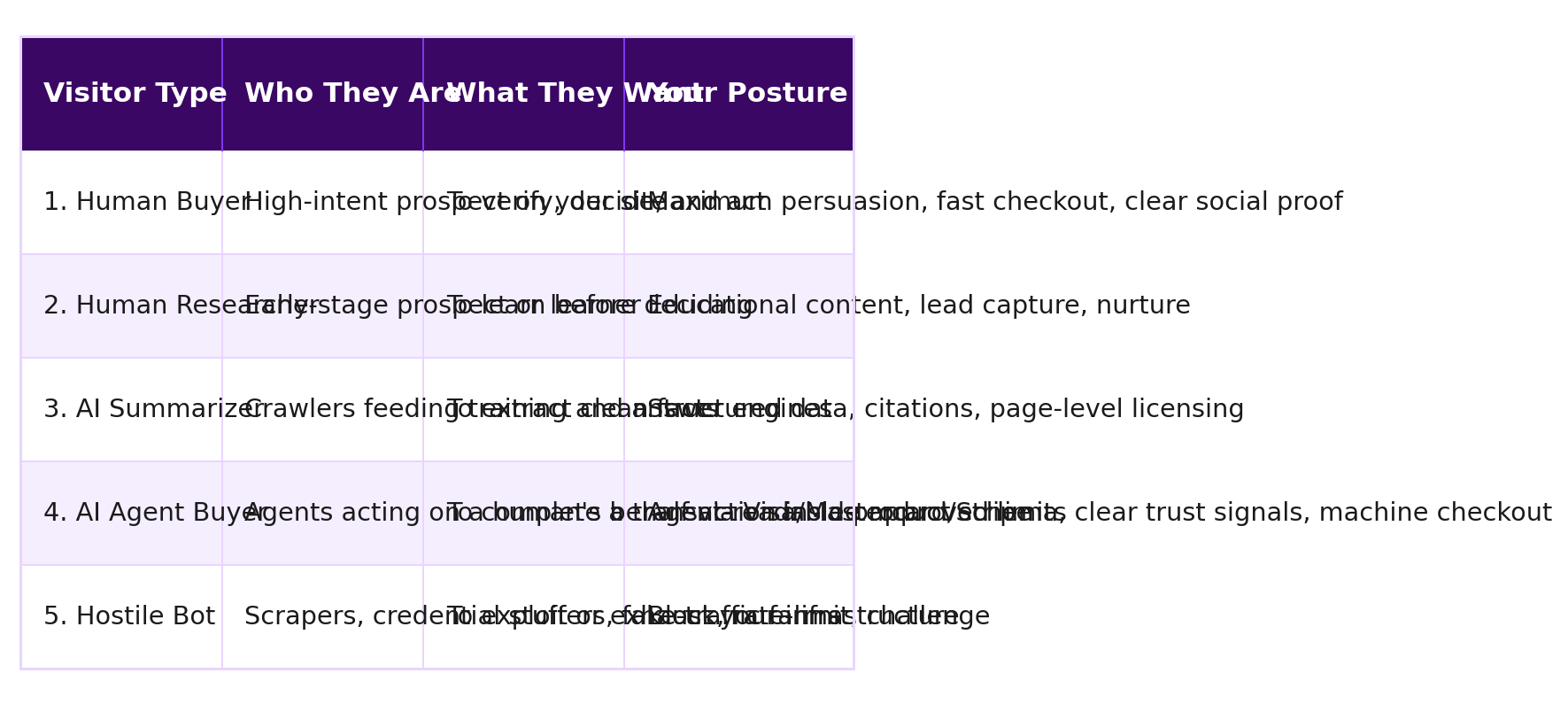
One reality. Five buckets. Five postures.
You do not pick one bucket and ignore the others. You audit which buckets are showing up on your site today, then build the right experience for each.
How Do I Apply The Machine Majority Doctrine This Week?
Spend a focused 2-hour block on this.
Step 1. Pull your last 30 days of traffic data. Split into verified human sessions, verified bots, and unknown.
Use Cloudflare bot scores, server logs, or your analytics platform's user-agent filtering. If your tool cannot split bots from humans, that is your first fix.
Step 2. Profile your bot traffic. Tag each crawler with intent. GPTBot, ClaudeBot, Google-Extended, PerplexityBot, BingBot, plus your hostile bots.
Cloudflare's data shows roughly half of crawler requests are training-bound and a third are mixed-purpose (Digital Applied). Decide your stance on each named crawler in your robots.txt.
Step 3. Score every important page against the 5 visitor types. For each page, answer "if a Human Buyer hits this, does it convert?" "If an AI Summarizer hits this, does it extract clean answers?" "If an AI Agent Buyer hits this, can it transact?"
You will find most pages were built only for type 1 or type 2. Types 3 and 4 are leaving money on the table.
Step 4. Pick your AI Mode posture before June 17. Decide page by page if you want to appear in Google AI Overviews and AI Mode or opt out. Build a list of cornerstone pages where being cited is a brand asset and a list of money pages where zero-click cannibalizes revenue.
Step 5. Add agent-readable assets. Product schema, FAQ schema, machine-readable pricing, clear merchant identity, and an /agents.txt or similar policy file. Mastercard's AP4M and Visa's ChatGPT integration both reward sites that look credible to a machine. That credibility is now a conversion lever.
Step 6. Block the hostile bucket properly. Tighten login flows because 94 percent of login attempts in Cloudflare's network are now bots (X / Elias). Add bot management, rate limits, and challenge pages. Stop paying hosting bills for traffic that is actively trying to break you.
Six steps. One afternoon. A reordered web business by Monday.
What Does The Machine Majority Doctrine Look Like For A Real Business?
Take an ecommerce brand doing $4 million a year selling skincare.
Before reclassification, the team optimized one funnel. Product page, reviews, add to cart, checkout. Bots in the analytics were noise to ignore.
After running the doctrine, the team finds that AI Summarizer traffic from ChatGPT and Perplexity is 8 percent of all bot visits, hitting ingredient pages and review aggregations heavily. Those pages had no schema. Zero citations back. The brand was being summarized invisibly.
The team adds product schema, ingredient citations with sources, and an /agents.txt allowing GPTBot and PerplexityBot on educational pages but blocking them on promotional pages.
Within 30 days, ChatGPT citations of the brand triple. Branded search rises 18 percent.
The team also discovers from server logs that 3 percent of new visits this month came through OpenAI ChatGPT outbound links. Those visits convert at 4.1 times the rate of paid Meta clicks because the AI did the qualifying first.
So the team builds a dedicated agent checkout. Clean product schema. Visa-readable cart. Refund language a machine can parse. Inside 60 days, the agent-driven channel becomes their second largest paid acquisition source by margin.
This is what The Machine Majority Doctrine does. It turns the bot half of your traffic from a tax into a channel.
What Should I Watch Next Before The June 17 Google Switch?
Five things, in order.
One. Google Search Console AI performance reports. Currently showing impressions but no clicks (Digiday). Watch for the click data drop. That is the moment publishers can actually decide whether to opt out.
Two. Cloudflare Radar's weekly bot percentage. The number has held between 53 and 60 percent since the crossover (X / Elias). If it pushes past 65, expect ad pricing models to fracture.
Three. Visa-ChatGPT consumer launch date. Visa says it expects most early transactions to still loop in a human approval notification (Los Angeles Times). When that approval step goes optional, agent conversion will spike overnight.
Four. OpenAI's redesigned ChatGPT platform with Codex and partner services. The redesign elevates third-party integrations and creates a new merchant surface inside ChatGPT itself.
Five. Page-level opt-out controls from Google, due within nine months under the CMA order (Digiday). Until those land, you only have a site-wide switch. Plan accordingly.
If you want help running The Machine Majority Doctrine on your site, mapping which of the 5 buckets are actually showing up, and rebuilding your funnel for the human-machine split, book a one on one AI Implementation Session here.
We will walk your server logs, score every page against the 5 buckets, and hand you a 30-day rebuild plan you can execute with your existing team.
TL;DR
- Cloudflare Radar confirmed June 3 that bots now account for 57.5 percent of HTML web traffic, the first machine majority in internet history (Digital Applied).
- UK CMA's June 3 order forces Google to let publishers opt out of AI Overviews and AI Mode without losing organic rank, with the toggle going live June 17 (Let's Data Science).
- Visa and ChatGPT announced June 10 that AI agents can now complete purchases inside spending and merchant limits (Los Angeles Times).
- 94 percent of login attempts across Cloudflare's network are now bots (X / Elias).
- The Machine Majority Doctrine reclassifies every visitor into 5 buckets: Human Buyer, Human Researcher, AI Summarizer, AI Agent Buyer, Hostile Bot.
- Audit your traffic, profile your bots, score each page against the 5 buckets, pick your AI Mode posture before June 17, add agent-readable assets, and block hostile bots.
- Done well, this turns the bot half of your traffic from a tax into a second acquisition channel.
Frequently Asked Questions
Should I block all AI crawlers from my website?
No. Treat each crawler as a business decision. AI Summarizers can build citations and brand authority. AI Agent Buyers can drive transactions. Hostile bots should be blocked. Use robots.txt and your bot management tool to act crawler by crawler.
Will opting out of Google AI Mode hurt my organic rankings?
Per the UK CMA order, no. Google must keep organic rank intact when a publisher opts out of AI features. The risk is invisibility inside AI Mode itself, not loss of blue links. Run page-level reasoning before flipping any switch.
How do I get my products into ChatGPT and Visa's agentic checkout?
Start with clean product schema, public structured pricing, and Visa merchant credentials in good standing. Then watch for OpenAI's merchant onboarding for ChatGPT and Visa's agent program once it expands beyond initial partners.
Is bot traffic always bad for SEO?
No. Search engine crawlers and AI training bots can indirectly drive visibility and citations. The bad bots are credential stuffers, content scrapers selling your work, and fake-traffic farms. Telling them apart is the entire job of bot management.
What is the single most important step to take this week?
Split your analytics into human vs bot today. Until you can see the two audiences separately, every other decision is built on the wrong base number.
The web you grew your business on no longer exists. The web that replaced it has more machines than people, regulators redrawing the search interface, and payment networks letting agents spend on behalf of buyers.
The leaders who win the next 12 months will be the ones who reclassify their visitors, redesign for the 5 buckets, and stop optimizing for a human majority that does not exist anymore.
Run the doctrine this week.