The Bubble-Proof Operator: How to Win the AI Era Without Betting Your Business on the AI Bubble
Janet Yellen, the former US Treasury Secretary, went on CNN this morning and called the AI sector "bubble-like" (CNN).
She compared what's happening in AI to what we saw in crypto.
Three other things happened in the last 24 hours that put her warning in context.
Anthropic is closing a fundraise targeting a $900 billion valuation, more than doubling its $380 billion valuation from February and surpassing OpenAI's $852 billion (TechCrunch).
Meta sold $20 to $25 billion in investment-grade bonds yesterday, six months after a $30 billion bond raise, to fund AI infrastructure (Yahoo Finance).
Apple delivered a record March quarter, $111.2 billion in revenue and 17% growth, but the stock barely moved (CNBC).
Read those four headlines together and the picture is clear.
The AI capital cycle is now running hot enough that the people who steered the 2008 financial crisis are sounding alarms.
That doesn't mean stop using AI in your business. It means the opposite. The right move now is to be a Bubble-Proof Operator.
Let me explain.
What did Yellen actually say about the AI bubble?
In a CNN interview that aired Friday morning, former Treasury Secretary Janet Yellen told Erin Burnett that the AI sector shows "bubble-like activity," directly comparing it to the crypto cycle that ended in 2022 (CNN, Instagram clip).
She didn't say AI is fake. She didn't say it has no value.
She said valuations and capital flows are running ahead of the cash flows underneath them, and that's the signature pattern of a bubble.
This is the second former Treasury Secretary to flag this in a quarter. The Bank of England flagged similar concerns in its April Financial Stability Report.
Yellen's framing matters because she chairs no AI lab and runs no fund. Her job for years was to spot mismatches between public market enthusiasm and underlying earnings.
She's spotting one.
How does Anthropic's $900 billion valuation fit the bubble pattern?
Anthropic's numbers, on their own, are stunning.
The company's annualized revenue run rate just crossed $30 billion publicly, and is reportedly closer to $40 billion internally (TechCrunch).
Even at $40 billion, a $900 billion valuation prices Anthropic at roughly 22x revenue, with most of that revenue still being reinvested in compute, not profit.
For context, Microsoft trades at about 14x revenue. Apple trades at about 9x. Both have positive free cash flow in the hundreds of billions.
Anthropic raised at $380 billion in February. Less than three months later it's targeting $900 billion. That's a 137% jump in private valuation in a single quarter (Reuters).
The valuation could be right. Anthropic's models are leading developer preference in 2026.
It could also be the canonical chart investors look at five years from now and shake their heads.
You don't need to predict which. You need to make sure your business doesn't depend on the answer.
Why is Meta borrowing $25 billion to spend on AI?
Meta's bond sale this week is the loudest tell yet.
The company is borrowing $20 to $25 billion in investment-grade debt to fund AI infrastructure (Yahoo Finance).
This comes six months after Meta's $30 billion bond raise, one of the largest corporate debt transactions in history (Yahoo Finance debt).
That's $55 billion in fresh debt for a company that already generates massive operating cash flow.
Translation: even Meta, with $185 billion in cash flow optionality, doesn't want to fund AI capex purely from earnings.
Why? Because operating cash flow is finite. AI infrastructure isn't.
Meta has now publicly said it will spend $125 to $145 billion on AI capex in 2026 (Asia Nikkei). That's higher than the entire annual revenue of Coca-Cola.
When Meta is borrowing to fund the AI race, the message to small business owners is clear.
The hyperscalers are betting that AI revenue will grow faster than the debt service. If they're right, you're riding their tailwind for free. If they're wrong, the bubble pops on them, not you.
Either way, your job isn't to compete in the AI capital arms race.
Your job is to deploy the output without taking on the risk.
What is The Bubble-Proof Operator?
Let me name what's happening so you can plan around it.
The Bubble-Proof Operator is a small business owner who uses AI to compound revenue and margin without taking on the financial, vendor, or strategic risk of the AI bubble itself.
Three principles define one.
Principle 1: Pay-as-you-go, never debt-funded.
Bubble-proof operators don't take loans to buy AI tools. They don't lock into multi-year contracts. They use month-to-month subscriptions, pay-per-token APIs, and free tiers wherever possible.
If the AI capital cycle slows, they cut spend in 30 days, not 30 months.
Principle 2: Multi-vendor, never single-bet.
Bubble-proof operators run their workflows across at least two AI vendors. ChatGPT plus Claude. Gemini plus Llama. Open weight plus closed.
If any one provider faces a valuation correction, lawsuit, or outage, the business keeps running.
Principle 3: Customer cash flow, never speculative spend.
Bubble-proof operators measure every AI dollar against actual customer revenue, not vibes. They run a simple equation: "Did this AI tool save me X hours or generate Y dollars this month?"
If the answer is no within 90 days, they cut it.
These three principles cost nothing to adopt. They protect everything you've built.
How do I run a Bubble-Proof AI stack this quarter?
Here's the four-step playbook I run with clients.
Step 1. List every AI tool, subscription, and contract in your business right now. Most owners are surprised how many are auto-renewing without measurement.
Step 2. For each one, attach a real metric. Hours saved per week. Revenue generated per month. Cost replaced per quarter.
If you can't attach a number, it doesn't stay.
Step 3. For your top three AI use cases, set up a backup model on a different vendor. ChatGPT primary, Claude backup. Gemini primary, GPT secondary. Document the swap procedure in plain English.
Step 4. Cap your total AI spend at a percentage of revenue you'd be comfortable losing if every tool disappeared overnight. For most businesses, that's 2-5%.
This is exactly what we help clients build inside the 8 Figure AI Toolkit. Our AI Tool & Tech Stack Picker maps the right model to each task and our CFO Pack helps you run the numbers like a Bubble-Proof Operator instead of a hopeful one.
How does this compare across the four biggest AI bets right now?
Quick snapshot of where the capital is concentrated and where the risk lives.
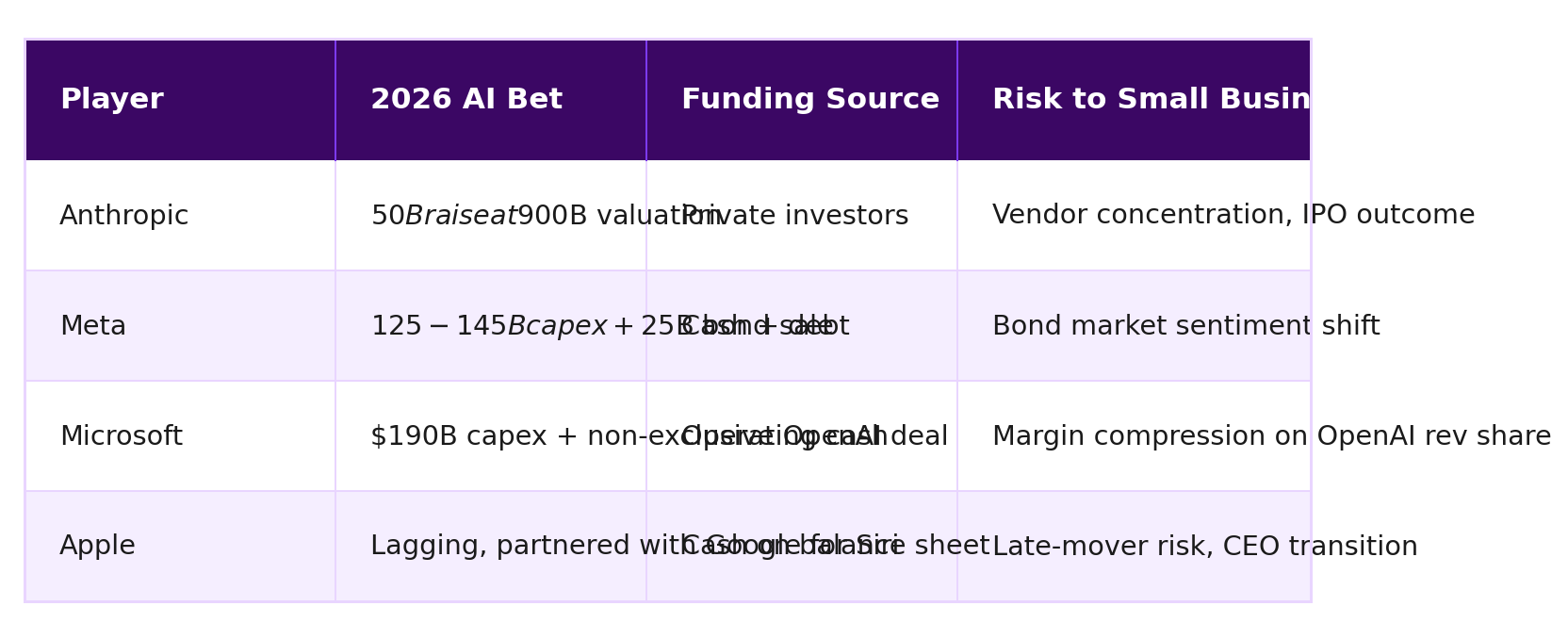
Two takeaways.
One, every major player has a real vulnerability that didn't exist 12 months ago.
Two, none of them are vulnerabilities you can hedge by stock-picking. You hedge them by being a Bubble-Proof Operator on the consumption side (CNBC Microsoft, TechCrunch Anthropic).
What does the Apple earnings story tell us about the bubble?
Apple posted its best March quarter ever yesterday: $111.2 billion in revenue, 17% growth, EPS up 22%, services hitting an all-time high (CNBC).
Tim Cook confirmed a "more personalized Siri" is on the way this year, with Apple partnering with Google for AI while continuing to develop its own models.
Apple stock rose only modestly after hours.
That's the bubble tell.
A nearly perfect quarter from the most valuable company on earth, with a credible AI roadmap, barely moved the needle.
Why? Because Apple isn't pricing in AI hype. It's pricing in AI execution. And the market is starting to demand the same from everyone else.
For small business owners, this is the most useful market signal in months. The era of "tell me you're using AI and I'll pay you a premium" is closing. The era of "show me the cash flow your AI generated" is opening.
That's the era a Bubble-Proof Operator wins.
Common mistakes business owners are making this week
Mistake 1: Reading "bubble" as a reason to wait.
A bubble is a financing pattern, not a usage pattern. AI tools work whether the equity multiples make sense or not. The right response to a bubble warning isn't to stop using AI. It's to use it cheaply, multi-vendor, and with measurement.
Mistake 2: Locking into multi-year prepaid contracts.
If a vendor offers you 30% off for prepaying three years right now, ask yourself why they need the cash. Most enterprise AI vendors are trying to lock revenue ahead of a possible market reset. Stay month-to-month.
Mistake 3: Using one model for everything.
If your entire business runs on a single AI provider, you have a concentration risk that grows every month. Spread the workload before a disruption forces you to.
Mistake 4: Treating AI capex like marketing spend.
Marketing spend that doesn't perform can be cut tomorrow. AI tooling that you've built workflows around is harder to unwind. Treat it like a subscription audit, not a creative budget.
What should I actually do today?
Three moves you can finish before the weekend.
Move 1. Open your accounting software and pull every AI-related charge from the last 90 days. List them.
Move 2. Next to each one, write the dollar value or hour value it generated. Be honest. If you can't attach one, that's the answer.
Move 3. For your top use case, set up a free trial of a competing model and run the same workflow through it. Compare the output.
That's a one-hour Bubble-Proof Operator audit you can do this Friday.
If you want a partner who has done this hundreds of times across coaching, services, real estate, products, and consulting businesses, my team runs free 1 on 1 AI Implementation Sessions.
We'll map your stack, identify where you're paying the bubble premium, and build you a Bubble-Proof Operator playbook for the next 90 days.
Grab a spot here: https://go.8fig.ai/1-on-1
The bubble talk is going to get louder over the next two quarters.
The owners who quietly compound revenue while staying off the bubble's risk curve are going to look like geniuses by the end of 2026.
You can be one of them.
FAQ
Q: Is AI actually in a bubble? A: Multiple credible signals say yes for the financial layer. Janet Yellen called it "bubble-like" on May 1, 2026 (CNN). Anthropic's valuation tripled in 90 days. Meta is borrowing $55 billion in 6 months for AI capex. The technology is real. The financing might be ahead of the fundamentals.
Q: Should small businesses stop using AI tools? A: No. AI usage and AI investment are different layers. The tools work and they save real money. The risk is concentrated in equity valuations and vendor balance sheets, not in your day-to-day workflows.
Q: What is the Anthropic $900 billion valuation about? A: Anthropic is closing a fundraise of roughly $50 billion at a valuation up to $900 billion, surpassing OpenAI's $852 billion. Annualized revenue is $30-40 billion, which prices the company at 22x revenue (TechCrunch).
Q: Why is Meta selling $25 billion in bonds? A: To fund 2026 AI capex of $125 to $145 billion. The bond sale is six months after a $30 billion bond raise. Meta wants to preserve operating cash flow flexibility while funding the AI build-out with cheap debt (Yahoo Finance).
Q: How much should I spend on AI as a percentage of revenue? A: Most Bubble-Proof Operators we work with cap AI spend at 2-5% of monthly revenue, with each line item tied to a measurable hours-saved or revenue-generated metric.
TL;DR
- Janet Yellen called the AI sector "bubble-like" on May 1, 2026, comparing it to crypto (CNN).
- Anthropic targeting $900B valuation (up from $380B in February) on a $50B raise (TechCrunch).
- Meta selling $25B in bonds to fund AI capex, on top of $30B raised six months ago (Yahoo Finance).
- Apple beat earnings but stock barely moved, signaling the market shift from AI hype to AI execution.
- The right response is to be The Bubble-Proof Operator: pay-as-you-go, multi-vendor, customer-cash-flow first.
- One-hour audit this Friday: list AI spend, attach metrics, set up backup vendors, cap spend as a percentage of revenue.
You don't need a bubble to win in AI. You need the discipline to use the tools without owning the risk.
Rooting for you.