
The Agent Wallet Stack: How Stripe Link, Google's UCP, and Salesforce Headless 360 Just Made AI Agents Real Customers
This week, an AI agent learned how to pay you.
At Stripe Sessions 2026 on Wednesday, Stripe announced 288 new products and features. The biggest one is Stripe Link wallets for AI agents (Stripe Newsroom).
A Stripe Link wallet lets a person connect their cards, banks, and subscriptions, then authorize an AI agent to spend on their behalf using approval flows (TechCrunch).
The same day, Stripe announced a partnership with Google to bring agentic checkout to AI Mode and the Gemini app, plus three other major AI platforms, using the new Universal Commerce Protocol (UCP) (Payments Dive).
And Salesforce's Headless 360 platform, announced at TDX 2026 on April 15, is now in production, exposing every Salesforce capability through APIs and MCP for agents to use without ever opening a browser (Mindzvue).
Three announcements. One story.
The infrastructure for AI agents to discover, purchase, and execute on behalf of customers is now live in the payment system most small businesses already use.
If your store, service, or membership site can't accept a transaction from an AI agent in 2026, you're losing customers you can't even see.
What did Stripe actually launch at Sessions 2026?
Stripe's annual developer conference produced more product news in a single day than most companies ship in a year. Three pieces matter most for business owners.
One. Link wallets for agents. Customers connect cards, bank accounts, and recurring subscriptions to a single Link wallet. They then authorize specific AI agents to spend within preset budgets and approval rules. Agents check out using Link the way a human checks out today, with the customer in the loop only when needed (TechCrunch).
Two. The Universal Commerce Protocol. Stripe partnered with Google so an AI agent inside Gemini, Google AI Mode, ChatGPT, or Claude can complete a purchase from any Stripe-powered merchant without ever leaving the agent interface. UCP standardizes the way agents handshake with merchants for product info, pricing, fulfillment, and payment (Stripe Newsroom, StartupHub).
Three. Net new payment primitives. Stripe shipped support for AI-native business models including pay-per-token, agent fees, outcome-based pricing, and shared revenue splits between AI vendors and the merchants whose data and services they rely on.
Stripe President John Collison framed it bluntly on Bloomberg: this is the economic infrastructure for the agent internet (Bloomberg).
What is The Agent Wallet Stack?
Let me name what's happening so you can plan around it.
The Agent Wallet Stack is the four-layer infrastructure required for an AI agent to act as a real customer in your business.
It is specifically:
Layer 1. Discovery. An agent reads your website, product feed, FAQ, or API and decides whether to recommend you. Powered by AI Overviews, ChatGPT citations, and structured data on your site.
Layer 2. Decision. The agent compares your offer against alternatives. Powered by reviews, pricing transparency, schema markup, and direct API responses.
Layer 3. Authorization. The customer approves the spend, often inside an agent wallet. Powered by Stripe Link, Apple Pay, Google Wallet equivalents, and rule-based approval flows.
Layer 4. Transaction. The agent executes the purchase, books the calendar slot, signs up for the subscription, or returns the item. Powered by UCP, MCP, Stripe APIs, and headless platforms like Salesforce Headless 360.
Most small businesses today are weak in three of the four layers and have never tested the fourth.
That changes this quarter.
Why does Salesforce Headless 360 matter for non-Salesforce users?
Even if you don't use Salesforce, Headless 360 is a leading indicator.
The largest enterprise software platform on earth just admitted that the user interface is no longer the center of the system (Mindzvue).
Parker Harris, Salesforce's co-founder, asked at TDX 2026, "Why should anyone need to log into Salesforce to get work done?" That's the same question every other software vendor is now asking about themselves.
Translation: in 2026, the customer-facing UI is becoming optional. The API and the agent are becoming primary.
If you run a business where humans still have to fill out a form, log into a portal, or click 14 buttons to buy from you, the agents are quietly going to your competitors who exposed clean APIs.
You don't need to rebuild your tech stack. You need to expose it cleanly so agents can read it and act on it.
What does this mean for small business owners right now?
Three direct implications.
One. AI agents are about to become a measurable revenue channel.
Stripe estimates "agent commerce" could process tens of billions in transactions in the next 18 months (Stripe Newsroom). That money will flow disproportionately to merchants whose products are visible, structured, and Link-compatible.
If you sell anything online, this is your new top-of-funnel.
Two. Your data feed is now your storefront.
When a Gemini or ChatGPT agent decides what to recommend, it isn't browsing your site like a human. It's reading your product feed, schema markup, FAQ, and pricing API.
Audit your product data the way you audit your homepage. The look and feel doesn't matter. The accuracy and completeness do.
Three. The most important sales rep in your business in 2027 won't be human.
Agents will recommend, compare, and transact. The merchants who make their lives easy will win. The merchants who require humans to fill out forms will lose share quietly, every day, until they wake up with a revenue gap they can't explain.
How can a small business get ready for The Agent Wallet Stack this quarter?
Five practical moves you can finish in the next 60 days.
Move 1: Audit your structured data.
Run your top 10 product or service pages through Google's Rich Results Test. If schema markup is missing or incomplete, that's where you start.
Every missing field is a place an agent can't recommend you.
Move 2: Publish a clean public FAQ and pricing page.
This is the cheapest, highest-leverage AI-readiness move you can make.
If your prices, hours, services, and policies are scattered across a chatbot, an email signature, and a Google Business profile, an agent will skip you for the merchant who put it on one page.
Move 3: Add Stripe (or upgrade your Stripe configuration).
If you take payments through Stripe, you're already a step ahead. Make sure you've enabled Link, kept your product catalog up to date, and set up customer portals where agents can manage subscriptions on behalf of users (Stripe Newsroom).
Move 4: Test buying from yourself with an agent.
Open ChatGPT or Gemini. Ask it to buy or book your service the way a customer would. Watch where it fails.
That's your roadmap.
Move 5: Expose your booking and CRM to agents safely.
If you use Salesforce, look at Headless 360 and Agentforce. If you use HubSpot, GoHighLevel, or another CRM, check whether they've added MCP or agent APIs. Most platforms shipped agent APIs in Q1 2026.
Your CRM is now the back office for an agent workforce. Treat it like one.
How do the major AI commerce platforms compare in May 2026?
Quick snapshot of where the agent commerce stack lives.
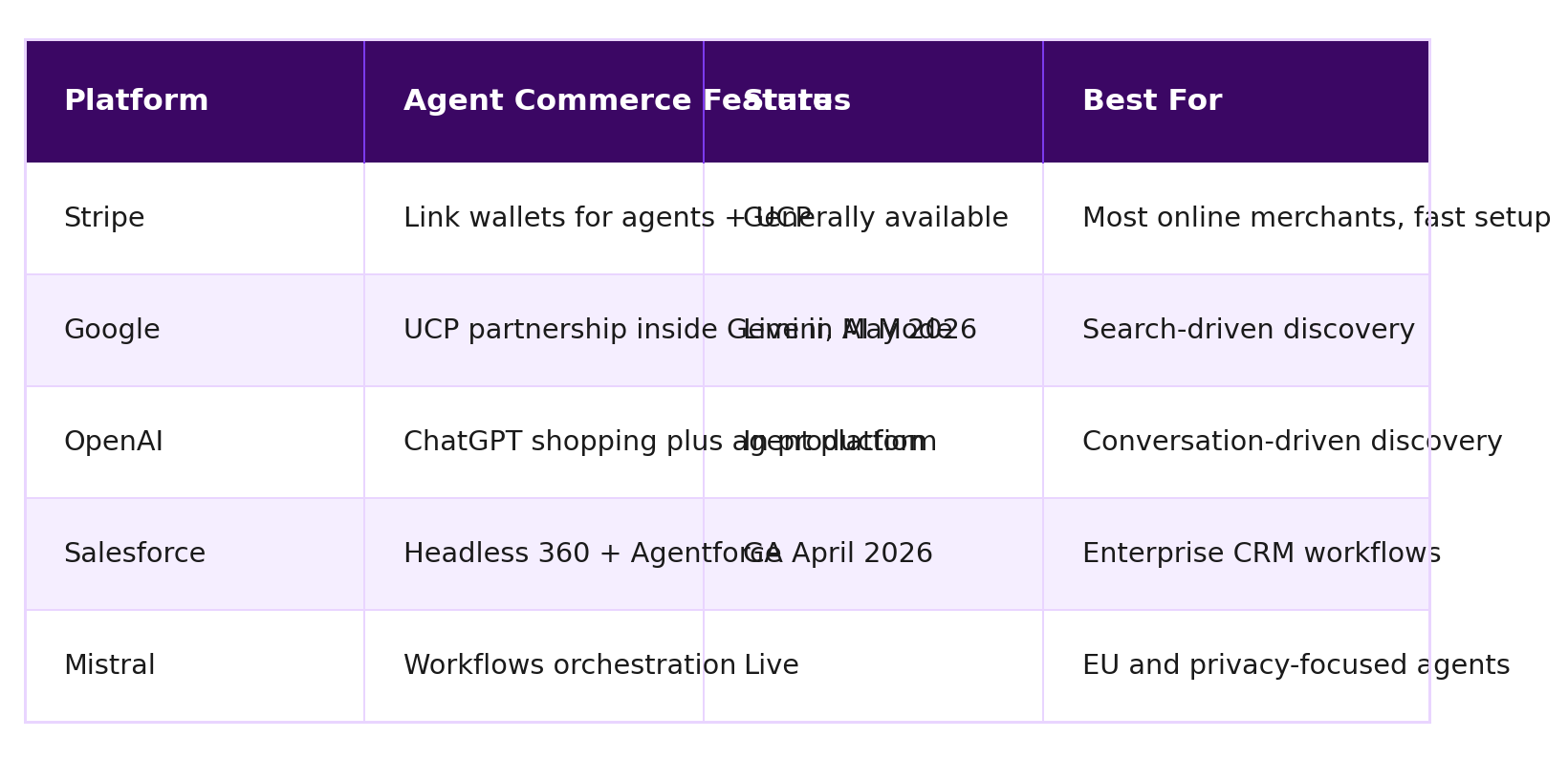
If you sell anything online and you aren't on Stripe, the cost of switching just went down and the cost of staying off it just went up (Stripe Newsroom, Payments Dive).
Common mistakes business owners are making this week
Mistake 1: Treating "AI agent commerce" as a future problem.
The infrastructure is live this week. The customer behavior is already moving. The merchants who treat this as a 2027 problem will be playing catch-up while early movers compound advantage.
Mistake 2: Believing humans will stay in every transaction.
For high-stakes purchases, yes. For routine restocks, subscriptions, services, and replacements, no. The default action is shifting to "agent handles it, human approves if needed."
Mistake 3: Ignoring product data hygiene.
Most small businesses have product titles, descriptions, prices, and inventory in three different places that don't match. Agents notice. Customers don't get recommended to the messy ones.
Mistake 4: Building agent UX as a feature on top of a broken process.
If your booking system is slow or your customer support is incoherent, exposing it to agents will make the failure visible at scale. Fix the process first, then automate.
Should I rebuild my entire site for AI agents?
No.
You should make sure the parts of your site agents already touch are clean, structured, and accurate.
That's mostly a content and configuration job, not a development project.
In our 1 on 1 AI Implementation Sessions, we run business owners through a 4-layer Agent Wallet Stack audit. We map the gaps in your discovery, decision, authorization, and transaction layers, then build a 30-day fix list prioritized by revenue impact.
If you want to see exactly what an AI agent sees when it lands on your business, grab a free spot here: https://go.8fig.ai/1-on-1.
If you'd rather start with self-serve tools, the 8 Figure AI Toolkit includes our Answer Engine Expert for AI citation readiness, Website SEO and Copywriting Conversion Analyzer, and Customer Acquisition Strategy Coach, all built for the agent commerce era.
The merchants who set up The Agent Wallet Stack in May 2026 are the ones agents will recommend by default in 2027.
That's where to put your attention.
FAQ
Q: What is Stripe Link for AI agents? A: Link is a digital wallet where a customer connects cards, bank accounts, and subscriptions, then authorizes specific AI agents to spend within set budgets and approval rules. The wallet handles checkout for agent-driven purchases the way Apple Pay handles human checkout today (TechCrunch).
Q: What is the Universal Commerce Protocol (UCP)? A: UCP is a Stripe-led standard that lets AI agents inside Gemini, Google AI Mode, ChatGPT, and Claude complete purchases from Stripe-powered merchants without leaving the agent interface. Stripe partnered with Google to launch UCP at Stripe Sessions 2026 (Payments Dive).
Q: What does Salesforce Headless 360 mean in plain English? A: It means every Salesforce feature is now exposed through APIs and the Model Context Protocol so AI agents and other apps can use Salesforce capabilities without ever opening the Salesforce browser interface. The UI becomes optional (Mindzvue).
Q: Will AI agents really buy things on behalf of customers in 2026? A: They already are, in pilot form. With Link wallets, UCP, and managed agent platforms shipping in April and May 2026, expect tens of billions in agent-driven transactions in the next 18 months. The volume is small today and growing fast.
Q: Do I need to be on Stripe to participate? A: No, but it's the easiest path. Stripe has the largest agent-ready merchant base, the Link wallet, and the UCP standard. Other processors will follow with their own agent-checkout features in 2026 and 2027.
TL;DR
- Stripe Sessions 2026 announced 288 launches, including Link wallets for AI agents and a Google partnership for Universal Commerce Protocol (Stripe Newsroom).
- Salesforce Headless 360 hit GA in April, exposing the entire CRM through APIs and MCP for AI agents (Mindzvue).
- AI agents can now discover, decide, authorize, and transact on a customer's behalf using infrastructure that's live this week.
- This is The Agent Wallet Stack: four layers any business needs to be visible, decision-ready, payable, and executable by an agent.
- Five-move readiness plan: clean schema, public FAQ and pricing, Stripe Link, test buying from yourself with an agent, expose CRM safely.
- Stripe estimates tens of billions in agent commerce volume over the next 18 months. Early movers win.
The most important sales rep in your business next year may never log in.
Make sure they can find you, trust you, pay you, and walk away happy.
Rooting for you.