The $725 Billion Tailwind: What Big Tech's Capex Surge and Google's Ad Decline Mean for Your Business in 2026
Yesterday afternoon, the four biggest tech companies on earth all posted earnings on the same day.
The headline number wasn't revenue. It was $725 billion.
That's what Microsoft, Meta, Alphabet, and Amazon now plan to spend on AI infrastructure in 2026, up from a previous estimate of $670 billion just last quarter (Yahoo Finance).
Microsoft alone now projects $190 billion in 2026 capital spending (CNBC). Meta lifted its forecast to $125 to $145 billion (Asia Nikkei). Alphabet pushed its full-year capex toward $190 billion as Google Cloud revenue jumped 63% (CNBC).
Buried in Alphabet's same report was a quieter number that matters even more for small business owners.
Google Network advertising revenue fell 4% to $6.97 billion (PPC Land).
Translation: AI Overviews and AI Mode are now resolving so many user queries inside Google's own properties that the ads served on partner websites are shrinking.
That's the story. The biggest AI tailwind in business history is showing up in your business as broken Google traffic.
If you only watch one number this year, watch how those two trends collide on your top line.
What just happened with hyperscaler capex?
Wednesday's earnings calls set new records nobody saw coming three months ago.
Microsoft. Q1 fiscal 2026 profits jumped 23% to $31.8 billion on $82.9 billion in revenue. Microsoft Cloud crossed half of total revenue. Capex guidance lifted to $190 billion, including $25 billion of memory price increases (The Register, CNBC).
Alphabet. Q1 2026 revenue hit $109.9 billion, up 22%. Net income rose 81% to $62.6 billion. Google Cloud revenue accelerated to 63% growth. Capex pushed toward $190 billion for the year (CNBC Alphabet, Google Blog).
Meta. Revenue rose 33% to $56.31 billion in Q1. Net income jumped to $26.77 billion. Capex guidance lifted to $125 to $145 billion. The stock dropped 6% on the news (Simply Wall St).
Amazon. Reports later today. Wall Street already expects another double-digit capex bump.
Add it up and the four hyperscalers are deploying more capex into AI in a single year than the entire US auto industry's annual revenue.
This isn't hype. It's poured concrete and shipped GPUs.
What is The $725 Billion Tailwind?
Let me name what's happening so you can plan around it.
The $725 Billion Tailwind is the cascading benefit small business owners get from hyperscaler AI investments they didn't pay for.
Here's how it works.
Microsoft, Meta, Alphabet, and Amazon are spending roughly three quarters of a trillion dollars in 2026 to build the AI infrastructure that you and your team can rent for pennies. Models. Data centers. Inference chips. Networking. Power. Cooling. Engineers.
You will never have to write a check for any of it.
You just buy the output.
That's why the price of intelligence keeps falling. State-of-the-art models that cost $60 per million tokens 18 months ago now cost $3 (CNBC Microsoft). A small business that adopts AI today is riding a tailwind nobody else paid for.
But there's a catch.
Tailwinds also blow over the unprepared.
The same hyperscalers spending $725 billion on AI are using it to vacuum up traffic and revenue that used to flow to small businesses through ads, search, and partner networks.
The Tailwind is real. It's also asymmetric.
The owners who notice early get a free ride. The owners who don't get run over.
How is Google's ad business actually changing?
This is the most underreported chart of the year.
Google's overall ad revenue is still growing. Search revenue alone climbed 12% to $54.2 billion in Q1 (PPC Land).
But Google Network revenue, the ads that get served on third-party publisher sites, fell 4% to $6.97 billion year over year. That's the steepest decline in recent reporting.
Why?
Because AI Overviews, AI Mode, and agentic commerce features are now resolving user queries inside Google's own properties. Users don't click out as often. The partner site never gets the impression. The publisher never gets paid. The advertiser doesn't get billed for a click that didn't happen.
Multiply that by tens of billions of queries.
If your business depends on:
- Affiliate traffic
- Display ads on owned content
- AdSense revenue from partner placements
- Organic clicks driving leads
You are paying The $725 Billion Tailwind tax in real time. Quietly. Every day. Without an invoice.
What does this mean for business owners right now?
Three direct implications.
One. Your AI tooling is about to get cheaper, fast.
Hyperscaler capex is a leading indicator of falling unit prices. Expect 30 to 60% price drops on premium AI tier subscriptions over the next 12 months as capacity outpaces consumer demand for the highest tiers.
Hold off on three-year prepaid contracts. Use month to month. Wait for the price war.
Two. Your traffic strategy needs a complete rebuild.
Search traffic alone is no longer a viable plan. You need three layers of demand capture:
- Owned audience (email, SMS, community)
- AI citation strategy (showing up inside ChatGPT, Gemini, Claude answers)
- Direct relationship channels (referrals, partnerships)
If 60%+ of your leads still come from cold Google traffic, you are exposed to a single point of failure that's actively breaking.
Three. Your competitors with deep pockets are about to deploy heavy AI.
Big companies with engineering teams are now spinning up AI-native operations on top of all this hyperscaler capacity. They will undercut you on speed, cost, and personalization within 12 months.
The way to survive isn't to outspend them. It's to outlearn them with the same tools.
How can a small business actually capture The $725 Billion Tailwind?
Here are the four moves I'd make this quarter.
Move 1: Replace your dumbest workflow with AI this week.
Pick the single most repetitive task in your business. Email triage. Quote drafting. Lead enrichment. Customer onboarding. Replace one step with an AI workflow inside your existing stack.
You'll learn more in seven days of doing this than in seven months of reading about it.
Move 2: Build for AI citations, not just Google rankings.
Audit your top 10 pages. Ask one question for each: "If a ChatGPT user asked the question this page answers, would the model cite this page?"
If the answer is no, rewrite the page with named frameworks, fact-dense sourcing, original data, and clear question-and-answer structure. That's what gets cited.
Move 3: Stop building on rented land.
Email lists. SMS lists. Member communities. Owned media. Direct customer relationships.
Every dollar spent strengthening these is more durable than a dollar spent on Google or Meta ads in 2026.
Move 4: Pick the right AI tools for your specific business model.
Not all AI tools fit every business. The 8 Figure AI Toolkit was built specifically to match the right AI plays to your stage and industry. Our AI Tool & Tech Stack Picker helps you avoid wasting money on premium subscriptions you don't need. Our Answer Engine Expert helps you optimize your content for ChatGPT and Gemini citations.
Start there: https://8fig.ai
How do the four hyperscalers compare on AI investment?
Quick snapshot of the AI capex race for 2026.
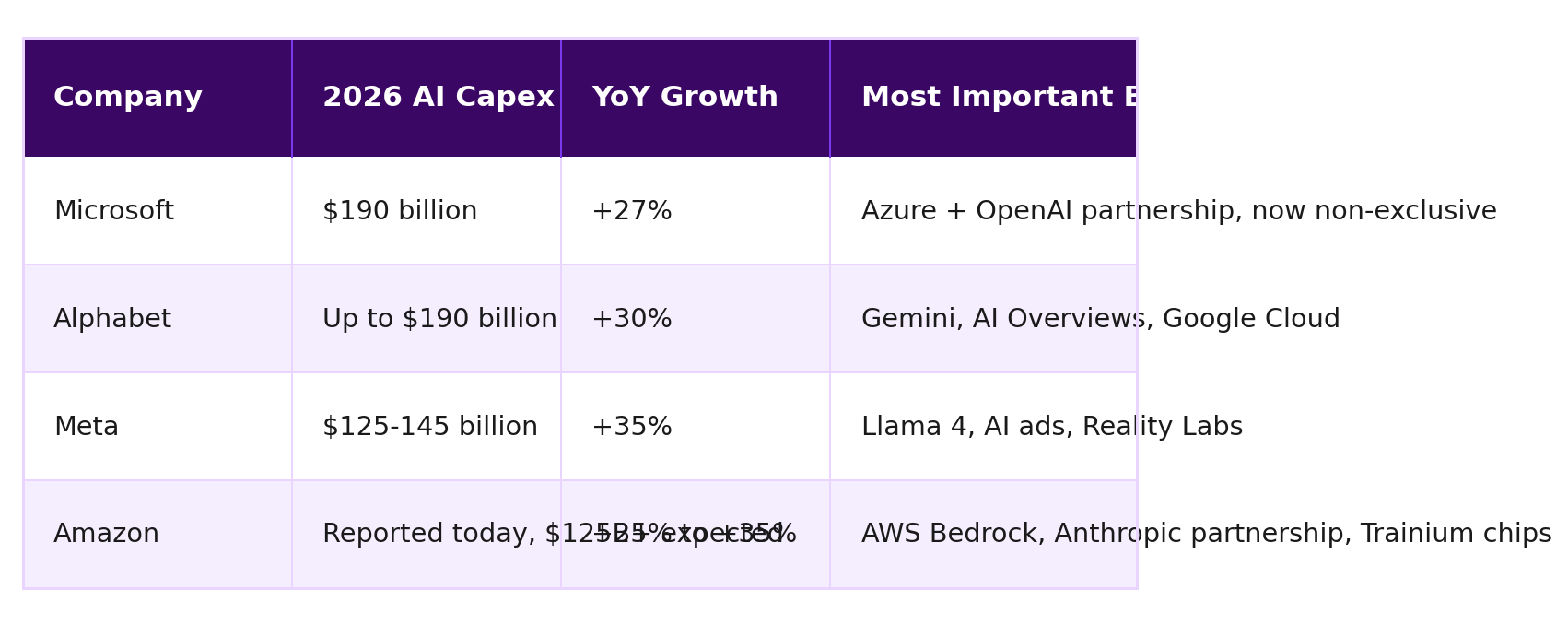
That's about $640 billion just from these four. Add Oracle, Tesla, and a wave of sovereign AI funds and the global figure passes a trillion (Yahoo Finance, CNBC, Asia Nikkei).
There is no scenario where AI gets less powerful or more expensive from here.
Common mistakes business owners are making this week
Mistake 1: Reacting to capex headlines as a stock story, not a business story.
You don't need to own Microsoft stock to benefit. You need to use the AI it's building. Most owners read these numbers as Wall Street news. They are operations news.
Mistake 2: Believing AI is a fad they can ignore.
Three quarters of a trillion dollars in 2026 alone is not a fad. The companies betting against AI in 2024 are quietly bankrupt or laying off in 2026.
Mistake 3: Doubling down on a Google-only traffic strategy.
If most of your leads still come from organic Google clicks, this quarter is your wake-up call. Diversify into AI-citation traffic, owned audience, and partnership channels before the AI Overviews chart gets worse.
Mistake 4: Outsourcing AI strategy to junior staff.
This is a CEO-level decision. The capital flows reshaping your industry are not delegable. You need to understand the playing field at a strategic level, even if you don't write the prompts yourself.
Should I take advantage of the new AI for Main Street Act?
Yes. It's the cherry on top of The $725 Billion Tailwind.
The federal AI for Main Street Act of 2026 funds AI training, tool adoption grants, and SBA-led advisory services for small businesses across the country. The first grant funding rounds are expected in the second half of 2026 (AdventurePPC).
It's specifically designed to close the AI adoption gap between you and the Fortune 500.
Three things to do this quarter.
One. Get on the email list of your local Small Business Development Center (SBDC). They will be the primary delivery channel for AI training and grant referrals.
Two. Build a written AI adoption plan for your business. Even one page. Grant programs reward businesses that have a clear plan, not generic intent.
Three. Track which AI vendors qualify as approved training and tool partners under the Act. The list will grow throughout 2026.
If you want help designing your plan, my team runs free 1 on 1 AI Implementation Sessions where we map your current AI footprint, identify the highest-leverage workflow to upgrade, and prepare you to take advantage of programs like the AI for Main Street Act.
Grab a spot here: https://go.8fig.ai/1-on-1
FAQ
Q: How much are Big Tech companies spending on AI in 2026? A: Microsoft, Meta, Alphabet, and Amazon are now projected to spend roughly $725 billion combined on AI infrastructure in 2026, up from $670 billion estimated last quarter. Microsoft alone is at $190 billion, Alphabet up to $190 billion, Meta $125 to $145 billion (Yahoo Finance, CNBC).
Q: Why is Google's ad revenue dropping for partner sites? A: Google Network advertising revenue fell 4% to $6.97 billion in Q1 2026. AI Overviews and AI Mode now resolve more queries inside Google's own properties, reducing clicks to partner websites and the ad impressions those clicks generate (PPC Land).
Q: Will AI tools get cheaper for small businesses? A: Yes. Capacity is being built faster than premium-tier consumer demand. Expect 30 to 60% price drops on AI tier subscriptions over the next 12 months. Avoid long pre-paid contracts.
Q: What is the AI for Main Street Act? A: Federal legislation that funds AI training, advisory services, and tool adoption grants for US small businesses through the SBA, SBDCs, SCORE chapters, and Women's Business Centers. First grant rounds expected in late 2026 (AdventurePPC).
Q: Should I cut my Google ad budget? A: Not cut, redirect. Keep what's profitable, then aggressively diversify into owned audience channels and AI-citation strategy so you don't depend on Google clicks alone.
TL;DR
- Microsoft, Meta, Alphabet, and Amazon are now projected to spend ~$725 billion on AI infrastructure in 2026, up from $670 billion last quarter (Yahoo Finance).
- Google Network ad revenue fell 4% as AI Overviews keep users inside Google (PPC Land).
- This is The $725 Billion Tailwind: small businesses get cheaper AI that they didn't pay to build, but lose traffic and ad revenue they used to count on.
- Three moves: replace one workflow with AI this week, rebuild your traffic strategy around AI citations and owned audience, prepare for the AI for Main Street Act.
- Don't outspend Big Tech. Outlearn them with the same tools.
The wind is at your back. So are everyone else's competitors. Move now.
Rooting for you.